Search This Blog

Showing posts with label Jules Feiffer. Show all posts

January 12, 2012

2011 Wrap: Books, Part II (Graphic Novels & Comic Books)

My seven-year-old, Dash, spent a little less of his time reading graphic novels in 2011 than he had in 2010 (and a little more trying to create his own, thrillingly enough—more on that another time). But a few of them made enough of an impression to reach the top of his, and therefore this, list.

It's no surprise that George O'Connor's Hera was first on the list; the initial book in his wonderful Olympians series of graphic novels was the subject of this blog's very first post ever. Even with our expectations sky-high for volume three, O'Connor managed to surpass them, taking a challenging and difficult mythological character and finding a way to spin her sympathetically. Like the first two volumes, Zeus and Athena, these get read over and over and over again. We're both really looking forward to seeing what he'll do with Hades, which comes out later this month.

Dash's other favorite this year was a rare nonfiction graphic novel: Matt Phelan's Around the World, which tells the tales of three amazing 19th-century solo circumnavigations. I think the biggest challenge for Dash is differentiating it from the fiction—sometimes it's hard to believe that Nellie Bly, Thomas Stevens, and especially Joshua Slocum really, truly made these journeys. Regardless, Phelan makes it all a vivid, unforgettable read.

But there's a third graphic novel, sort of, that I neglected to mention on the blog this year, though I meant to, and even thought I had. (That's kind of indicative of what 2011 was like overall, I'm afraid.) Nursery Rhyme Comics: 50 Timeless Rhymes from 50 Celebrated Cartoonists seems topical only for younger kids, by nature of its text. But its appeal is much broader, in fact, because each of these rhymes (some classic, some obscure) is illustrated—and really, more than that, its story told—by a different prominent artist, from Jules Feiffer ("Girls and Boys Come Out to Play") to the aforementioned George O'Connor ("For Want of a Nail") to David Macaulay ("London Bridge Is Falling Down," appropriately enough) to Gahan Wilson ("Itsy Bitsy Spider," again appropriately, and not so itsy bitsy) to Roz Chast ("There Was a Crooked Man"). Needless to say, the artists' takes on their respective rhymes are endlessly imaginative, and the book as a whole serves as a great example of how stories can be interpreted in an infinite number of ways. It's also a treasure as a sampler of so many of today's best active cartoonists, and neither Dash nor my three-year-old can get enough of it.

Next wrap post: Our family's favorite chapter books of the year.

[Cover image courtesy of First Second Books]

October 28, 2011

New Books: The Annotated Phantom Tollbooth

I wrote last year (have I really been doing this that long already?) about my premature attempt to read The Phantom Tollbooth with my then-five-year-old, so it's safe to say that Norton Juster's classic is one of my own favorites. (It even made the cut on a list of personal picks I had to come up with for a publishing course when I was 21, alongside Homer, Hammett, and Ford Madox Ford. Looking back, I simultaneously smile at pretentious youth and realize with some surprise that I might still pick the same authors.)

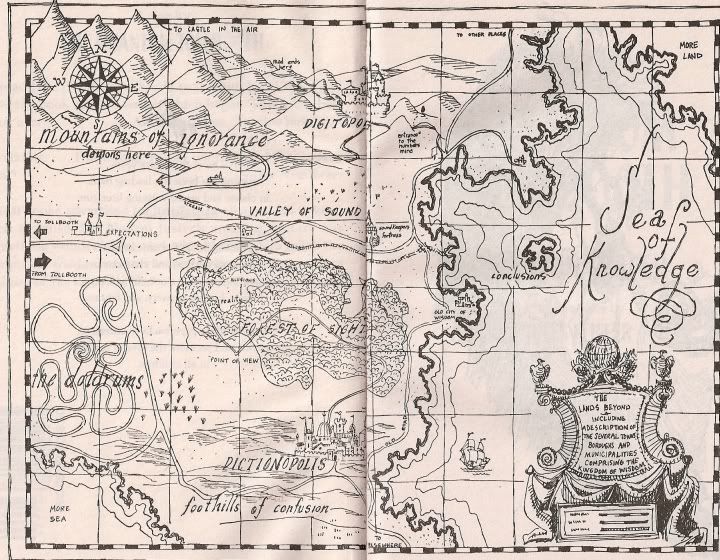
The brand-new Annotated Phantom Tollbooth is aimed directly at parents like me. It's exactly what it says it is: An extra-wide edition of the book, so designed to leave room for "annotations" in the margins (by historian and critic Leonard S. Marcus) about the ideas and inspirations behind Juster's characters and situations, as well as illustrator Jules Feiffer's eternally memorable rendering of them.

Marcus has combed interviews with and notes by both author and illustrator for these nuggets (which include the fact that Feiffer's illustration of the eccentric Whether Man, one of the first of the many unusual characters Milo meets on his journey, is pretty much a drawing of Juster himself). In an extended introduction, Marcus also relates the story of the book's origin as an especially close collaboration between two men sharing not merely a project, but a house in Brooklyn Heights. (Since Juster did the cooking for the housemates, Feiffer has joked that had he not agreed to illustrate The Phantom Tollbooth, he would literally not have been able to eat.)

Now, I don't think this is necessarily the best edition of the classic to use to introduce the book to one's own kids, full of distractions—and fairly serious-minded distractions at that—as it is. But it's almost a must-have for any adult (or teen, or maybe even tween) for whom this book holds a special place. And since it seems to have had that effect on many of us, chances aren't bad that our own kids will, in due time, come to enjoy leafing through the pages of this edition to find out where these two visionaries got their brilliant ideas.

Oh, and a year later, Dash asked to revisit The Phantom Tollbooth—and this time, everything clicked; he was drawn right in. Maybe a parent's (unpressured) dreams can come true after all, sometimes....

[Cover image courtesy of Knopf Books for Young Readers]

September 8, 2011

Security Blanket: Some Things Are Scary

Good picture books—all books, really, I suppose—are usually equal parts brilliant concept and brilliant execution, but most lean more heavily on one or the other. The concept of Some Things Are Scarya book originally released in 1969 but recently reissued, is simple enough: It's a book about scary things (real-life ones; this is not, as I misunderstood from the title at first, a Halloween book!). But it has a leg up on most of its subgenre: it was written by Florence Parry Heide, veteran author of classics like the Treehorn trilogy, and illustrated by Jules Feiffer, whose work on The Phantom Tollbooth and many other children's books is just one portion of an iconic career.

What this means in practice is that a seemingly straightforward idea is surprisingly clever, imaginative, and expressive. Each sentence of the book is simply something a kid would find scary—say, discovering the hand you're holding isn't Mommy's after all—but Heide keeps the throughline unpredictable, jumping smartly from personal, concrete fears (strange food on the dinner plate) to social anxieties (worry over being the last kid picked in pickup team sports) to kid existential angst (finding out your best friend has...another best friend) and then back to the concrete again.

Meanwhile, Feiffer visualizes every one of these fears in his inimitable fashion, capturing the feeling behind each with uncanny precision. (Click on the image below to see better what I mean.) He also imparts his usual wry humor, somehow without ever undercutting the validity of the feelings he's portraying. He's laughing with, not at, the situations, which allows parents to smile in recognition (and even personal remembrance in many cases), while kids can see that they're not the only ones who feel the way they feel.


It's nothing fancy—just a breath of fresh air in what could have been just another stale go at a common picture-book subject. And it's a testament to what kid-lit royalty is capable of. Indeed, it's evidence of why and how they became royalty in the first place.

[Photos: Whitney Webster]

June 17, 2010

Great Expectations


Now that my older son is reading chapter books, I find myself champing at the bit to introduce him to the classics. No, I’m not bringing Dickens, Tolstoy, or Melville to bedtime reading, but I do long to start him on childhood favorites of mine that I’m just certain he’ll love as much as I did. (And yes, I see the big parental danger sign in that last sentence. I’ll come back to it.)

My wife and I did pretty much the same with picture books when Dash began reading those, of course. But there’s a difference, since chapter books come in so many different levels of sophistication and maturity, from the basic introductory readers all the way up to Finnegan’s Wake. And if I’m honest with myself, many of the books I’ve been thinking of introducing to my five-year-old lately are books I didn’t read myself until I was more like ten or twelve.

Despite that, I recently pulled my old copy of Norton Juster’s The Phantom Tollbooth off the shelf. I knew some of the wordplay for which this book is justly renowned would go over Dash’s head at this point, but I thought the light, offbeat tone of the narrative would fit his sense of humor pretty well. (Plus there are all those great Jules Feiffer illustrations, which I knew he’d enjoy.) But as I opened it, I tried to remember when Tollbooth had become a cherished book for me. I couldn’t remember the precise age, but I was definitely a good deal older than five.

Still, the book wasn’t a failure with Dash by any means. We read it over several nights of bedtime reading, a few chapters at a time, and he was always ready to return to it each night. It did not become one of those sad, rejected chapter books that never get past the first evening or two, and then sit pathetically on the nightstand until I give up and put them back on the shelf. Dash liked the main characters, especially the trusty watchdog Tock, and the quest storyline. He liked the tone and the humor. He liked the book.

But I didn’t sense he was really into the book, not the way I had been. I’d supposedly prepared myself for this, having realized that Dash might still be a bit young for the weightier issues that make up much of the subtext of Tollbooth, or even that the book might not be as much to his taste as it had been for me. And yet...I couldn’t deny that I felt a little disappointment (which I concealed) that he didn’t just lurve it.

Which brings me back to that parental danger sign. There’s a certain hope in all parents, I think, when we introduce something we love to our kids, whether it be a favorite dessert or a treasured movie or book—and, yes, a certain amount of disappointment when they don’t appear to like it precisely as much as we did (or, worse yet, at all!). Mostly, we’re just after that rush that comes from watching our children experience something that blows them away; when we’ve primed ourselves to expect that, it’s disappointing not to get our fix.

But for me, there was something else, too, something a little uncomfortable: I kind of wanted my kid’s approval of my taste. I suppose even that’s natural enough in a way—I feel the same type of disappointment when a friend tells me she loathed a movie I liked and recommended, for instance. But I don’t want to burden my son with that kind of expectation, that kind of pressure to please me. Even though I’m not telling him openly that I really, really want him to like this book, I know he can probably sense it. (More and more, I come to know that kids sense everything.)

Now, I will certainly continue to bring the books and movies and everything else I loved as a kid to Dash’s attention when he seems ready for them (OK, maybe sometimes a little before). But I’m going to try to leave his personal experience of all this stuff in his own hands, and to keep my expectations—well, not necessarily low, but simply out of the equation as much as I can.

And maybe I’ll hold off on reading Philip Pullman’s (brilliant!) His Dark Materials series with Dash until he’s seven. Or at least six and a half.

[Photo: Whitney Webster]