Search This Blog

June 28, 2010

Interview: Elisha Cooper

A little while back, I posted about Elisha Cooper’s wonderful picture book Farm. As I mentioned then, I’ve been a fan of the author’s work for some time now, so I’m particularly thrilled that I had the chance to ask him a few questions recently for this blog’s very first (of many, I hope!) author interview.

Many, many thanks to Becky Amsel of Scholastic for facilitating everything…and many more to Cooper himself for his frank, well-considered responses. And then even more than that to both of them for providing me with the excerpts from the Cooper’s notebook for Farm shown below.

You Know, for Kids: How did you come to writing and illustrating children’s books? Was it something you always wanted to do, or was there something specific that drew you to them?

Elisha Cooper: Someone suggested it. I wish I could say I always wanted to write children’s books. What I always wanted was to play football for the Pittsburgh Steelers. But I have always loved drawing, and I’ve always loved writing. Children’s books are a nice combination of the two.

After college, I worked at
The New Yorker as a messenger, and when I was delivering manuscripts and art around the city I was sketching, and that became a book called A Year in New York. It was after that that someone suggested I write children’s books.

In any case, carrying a notebook is something I did when I was young, and something I do now. That hasn’t changed. It’s what I did for
Farm, driving out through the farm country of DeKalb County, Illinois, pulling over in my car and sketching barns.

I still play football, too, though not as much as I’d like. And not for the Steelers, except in my dreams.


YKFK: What authors and/or illustrators in the field (past or present) do you consider your biggest influences? And what are your own favorite children’s picture books, if that’s not a redundant question?

EC: I loved Edward Hopper growing up. I loved his watercolors. I went through a Van Gogh phase, too. And I liked Picasso, for that goat.

Mostly I like artists for their sketches. When I see a show—I went to the Picasso exhibit at the Metropolitan with my two daughters a few weeks ago—I’m always drawn to the sketches that were done before the finished painting. They’re better, rougher.

For writers, I loved Ernest Hemingway (embarrassing to admit liking Hemingway, but he could really write a sentence). I think I read a lot of Tintin and Asterix, too.

But wait! Looking above, I realize I’m mentioning artists who aren’t children’s-book artists. (I ducked the question.) I think that says something. I don’t think there has to be a distinction. Good art is good art. Bad art is bad art.

So I remember loving
Ferdinand for the art, along with In the Night Kitchen and Blueberries for Sal, for the same reason. The artists I admire now are ones like Peter Sís, Barbara McClintock, and Kevin Henkes.

YKFK: Farm is the second book of yours I’ve read with my kids (after Beach) that uses momentary or day-to-day details to capture the feel of the big-picture subject. Looking over your past work, I see that theme seems to run through many of your other books as well (Ballpark, Country Fair). Is that how you go about these “big subject” picture books from the start—building the whole out of the details? Or is it more just a technique you use when executing them?

EC: I wish I knew what my technique was! But I don’t. I just go to a location and start sketching, as I did with Farm. I accumulate details, really. Then I choose the ones I like, add them up, and mix them around, edit. Maybe there’s a theme there, or a technique. I don’t know.

I’m just looking for anecdotes, or gestures or images, that amuse me. Or that tell me something. I guess you could say I’m a believer in how little things add up to make something bigger than the thing itself.

YKFK: You started writing children’s books before you had kids yourself. Do you feel that your work on them, or your approach to them, has changed in any significant ways since your kids were born?

EC: No clue! If I had a psychiatrist or a psychologist, they could probably tell me. (I’m actually married to a psychologist, a professor at NYU, but she isn’t talking.) Not to punt on another question, but I don’t think having children has changed my work, though I do like showing my daughters the finished paintings I tape on our apartment walls at the end of the day. And I suppose my girls like the little notes about them that I placed in Farm, or the fact that I dedicated my most recent book, Beaver Is Lost, to them.

Maybe having my daughters has made me proud that I write children’s books.


YKFK: When I look at your illustrations, words like calm and peaceful pop into my head—which is, at the surface level, surprising for an artist who has lived most of his recent years in cities like Chicago and New York. But even your big-city scenes have a certain quietude to them. Do you seek that contrast in your work? Do you not even see it as a contrast, particularly?

EC: Calm and peaceful: two words no one would ever use to describe me! Really, ask my friends. Crude and opinionated, maybe. Or loud and stubborn. Or, well, you get the picture.

But I am also quite aware that my watercolors have a peacefulness to them. Ah, the paradox! And yet, this is not something I control. It’s just what comes out of my pencil and brush. I think it’s especially paradoxical that I paint my books to loud music: Green Day and the Shins and Vampire Weekend.

It’s possible—though this might be a stretch—that my paintings are my attempt to reach a calm, peaceful place. I must have one, deep down. I have my doubts, though, especially this month, as I pace around our apartment, painting my next children’s book, but all the time swearing at the television and the terrible soccer games in this year’s World Cup. Really, the soccer is driving me crazy.


[Author photograph by Shauna B. Peet; notebook images courtesy of Elisha Cooper and Scholastic.]

June 25, 2010

New Books: Adventures of a Cat-Whiskered Girl

Daniel Pinkwater has been writing children’s books for a long time. Long enough, in fact, that I remember reading some of them back in grade school. I recall really enjoying them, but he’s written so many—and was so prolific even back then—that I can’t figure out exactly which ones they were among the titles in his “works by” lists. (This is driving me nuts, to the point where I’ll probably soon be sighted in my local library sitting in the children’s section, leafing through multiple Pinkwater volumes.) Still, the author’s name summons a vague memory of cleverly offbeat writing.

Now, I was aware that Pinkwater, who’s also now known for his appearances reviewing children’s books on NPR, was still as prolific as ever, but I hadn’t kept up with his work of the last, oh, twenty years, not having had kids of the age to appreciate them until quite recently. (His chapter books seem to be generally labeled as for ages nine to twelve, though as always with such recommendations, that seems a little high on the low end to me. Come to think of it, it might be a little low on the high end, too, in his case.)

Adventures of a Cat-Whiskered Girl, his latest, is a spun off of two other recent Pinkwater novels, The Neddiad and The Yggysey (get it?); its main character, Big Audrey, was a supporting one in those two. But being unfamiliar with the previous books, as I am, isn’t a problem—the novel stands on its own. It’s narrated in the first person by Audrey herself—who, yes, has cat whiskers. Right off the bat, she informs the reader that she’s from another plane of existence—though, as we later discover, that’s not actually the explanation for the cat whiskers. (At this point, it all started to come back to me: One of the delights of Pinkwater’s writing is that the many, many unusual things that happen in it are treated matter-of-factly. They just are.)

Audrey begins the story in our plane of existence (well, Los Angeles, so kinda), having accompanied the heroes of the earlier books on their return from hers. She is working at a doughnut shop (about which she remarks, “Doughnuts are not unknown where I come from, but they are not used as food”), but decides her destiny lies elsewhere and heads east to Poughkeepsie, New York. There she finds work in a UFO-themed bookstore, whose owners instantly and happily convince themselves that her whiskered appearance mean she’s an extraterrestrial. (Audrey is too polite to disenchant them of their delight over this.)

She soon finds some new friends, both of whom are temporary residents of the local old-fashioned insane asylum: an extremely eccentric Vassar professor and a girl from the surrounding foothills who can read minds. Neither is really all that crazy, so when rumors about an old Dutch house in the area and flying saucers start to intersect with Audrey’s own hazy memories of her origins, they check themselves out to help her investigate.

I could go on—the story continues to calmly unfold along equally outlandish lines—but you get the point: This is strange stuff. And not that forced kind of strange one finds in many studiously offbeat kids’ books—the oddness just flows naturally, and each wild turn comes with a twinkle, the author’s winks at the reader. Pinkwater also folds sly references into the narrative—for instance, the characters have a brief discussion about whether bats eat cats or the other way around, which will strike a chord with fans of Lewis Carroll. (The best thing about this one was that while it was subtly done, it wasn’t one of those just-for-the-parents shout-outs—Dash, who’s been reading Alice in Wonderland recently, noticed the nod to Carroll immediately, maybe before I did.)

And Pinkwater writes masterfully. You always feel you’re in good hands as you take the ride with him—you may raise your eyebrows a lot, but he keeps you turning the pages to see what’s going to happen next. He’s funny, too, in a remarkably dry way; I had a bemused, ready-for-anything smile on my face all the way through the 288-page book. (If you happen to be reading it aloud to someone, you may even require brief pauses from time to time to regain your composure.)

Now, I suspect this kind of writing, as top-notch as it is, isn’t for everyone, child and parent alike. (I’m not sure what the bellwether would be for kids, but if you’re a parent who hates the early novels of Paul Auster, say, that might be a sign Pinkwater’s not for you.) But if you and your kids enjoy random, imaginative, and definitely weird plotlines, laced through with intelligent wit, I think you’ll find Adventures of a Cat-Whiskered Girl, as well as the rest of this author’s voluminous oeuvre, a gold mine.

[Image courtesy of Houghton Mifflin Harcourt.]

June 24, 2010

Upcoming Concert in NYC: Secret Agent 23 Skidoo

I was just preparing a new book post when some pre-emptive news hit my e-mail inbox: Secret Agent 23 Skidoo will be playing three venues in New York, for the City Parks Foundation, on July 7, 8, and 9. Parents and kids familiar with the artist’s 2008 debut CD, Easy, will know why this is so exciting: Secret Agent 23 Skidoo is the first real success story among the many attempts at “kid hop”—hip-hop for kids. The guy is a revelation, and I’d been interested in seeing a live performance by him since I first heard the album.

He’ll be playing three free concerts in two NYC boroughs on those dates: Pelham Bay Park in the Bronx on July 7 at 11 A.M.; Morningside Park in uptown Manhattan on July 8 at 10:30 A.M.; and Sara D. Roosevelt Park on the Lower East Side of Manhattan on July 9 at 10:30 A.M. Maybe I’ll see you at one of them! (For those not in the New York area, Secret Agent 23 Skidoo will also be making stops this summer in Colorado, North Carolina, Illinois, Philadelphia, and Washington, D.C., this summer, among other places—check out his website for details.)

And to whet your appetite, here’s a couple of videos of tracks from Easy, one of which demonstrates that his daughter, Saki, can bust some rhymes herself:


[Image courtesy of Secret Agent 23 Skidoo]

June 23, 2010

Security Blanket: PBSKids.org


Video games do not hold a place of honor in the world of most parents; they’re blamed for keeping kids indoors on sunny days, for exposing them to inappropriate violence, for giving them short attention spans. The general parental attitude toward them much like that toward candy: Our kids will inevitably seek way too much, and our job is to do our best to minimize the only marginally tolerable presence in their lives.

There’s some justification for this attitude, and I don’t want my five-year-old playing Red Dead Redemption any more than the next parent does. But as I learned during my years at Cookie, there are plenty of video games out there for kids that entertain cleverly and amusingly, some even while stretching their brains a bit—certainly as much as the various board games most of us played as kids did.

However, I must shamefacedly admit that mine is among those Luddite households that do not yet own one of the big gaming consoles, so my exposure to most of these games is limited to hearsay. (I’m working on getting some guest posts for this blog from friends who are more expert in the field.) For the time being, Dash’s primary video-gaming medium is the computer—specifically, the TV-show-related websites that contain branded games. His and our favorite among these is PBSKids.org, an astonishingly huge website that has hundreds of games on it, themed to the many kids’ shows the network broadcasts, from Sesame Street to Curious George to Super Why! (even, a bit spookily, Mr. Rogers’ Neighborhood—Fred Rogers is giving our kids games from beyond the grave somehow!).

The games are quite basic, generally of the Flash variety, but the sheer number of them means Dash never gets bored; the fact that it’s all free is a big plus, too. And they all have at least some educational aspect, from testing simple addition to teaching small scientific or sentence-structure lessons; in addition, he seems to have been motivated by the games to master his mouse and keyboard skills. While we don’t fool ourselves that this is “learning time,” exactly, it’s nice to think Dash might be getting some positives out of an activity he’s this excited about.

Which brings me to the other remarkable thing about the PBS Kids games: They’re actually fun, at least to a five-year-old, disproving my own childhood theory that any game labeled “educational” cannot be remotely enjoyable. Dash’s current top choice is a Sid the Science Kid game entitled Mystery Lunchbox, which, he says happily, “lets you watch a sandwich decay.” Yeah, he’s reached that age.)

The games area is merely part of the PBS Kids website, of course, which also includes show-related activities (little painting applications, for example) and, best of all, an immense archive of video clips. I’ve often wandered away while Dash was playing a game on the site and returned a few minutes later to find him watching a classic Grover sketch from Sesame Street that originally aired when I was a kid. He seems to revel in the choice: He can bounce from game to activity to clip and back to game with the click of a mouse, indulging his whims entirely in ways a five-year-old rarely gets to do.

It is true that we often have to tear him away from the website to, say, go outside on a sunny day. And inevitably, he wants to play these games far more often, and for far longer stretches of time, than we’re happy with—we haven’t evaded that battleground by any means. But at least with the PBS Kids site, we feel pretty good about what he’s playing when we’ve decided he’s earned a little candy today.

June 18, 2010

New Music: Jungle Gym


Having followed the kids’-music scene fairly closely for some years now, I sometimes forget that its foremost practitioners aren't in fact world-famous, even just among parents. So when I hear that someone like Justin Roberts has a new album out, it takes me a moment to remember that every parent in the U.S. may not instantly know, too.

But they probably should. Roberts’s past work has placed him in the highest echelon of the genre ever since his first children’s release in 1998; even if you didn’t know it, you’ve probably seen him performing interstitials on Nick Jr. from time to time. And his seventh release, Jungle Gym, is up to his high standard—my first thought on hearing its first track, the lilting “2 x 4,” was “Man, he’s a pro.

For the uninitiated, Roberts was among the first wave of musicians to import the indie-pop sound that has since taken over much of kiddie rock; his vocals have an earnest quality that sounds a bit like Ben Gibbard of Death Cab for Cutie. His lyrics are clever (the rhymes) and simple (the subject matter) all at once, and always flow through the songs lightly and easily, with nothing forced. On Jungle Gym, Roberts focuses on the experiential, providing kid’s-eye viewpoints on subjects like snow days, fire drills, and signing casts, and he gets the tone of a typical child’s reactions to these slices of life just right.

And the music on Jungle Gym is as catchy and energetic as ever. Upbeat songs like “Obsessed by Trucks” and “We Go Duck” will get your kids moving, but they also contain enough layered harmonies and complex underscoring to keep adult eavesdroppers happy. It’ll parents of a certain age in mind of the poppier sides of REM, Nick Lowe, and Robyn Hitchcock—or even, occasionally, of both the adult and kids’ music of They Might Be Giants.
[Image courtesy of Justin Roberts; photograph © Todd Rosenberg 2010]

June 17, 2010

Great Expectations


Now that my older son is reading chapter books, I find myself champing at the bit to introduce him to the classics. No, I’m not bringing Dickens, Tolstoy, or Melville to bedtime reading, but I do long to start him on childhood favorites of mine that I’m just certain he’ll love as much as I did. (And yes, I see the big parental danger sign in that last sentence. I’ll come back to it.)

My wife and I did pretty much the same with picture books when Dash began reading those, of course. But there’s a difference, since chapter books come in so many different levels of sophistication and maturity, from the basic introductory readers all the way up to Finnegan’s Wake. And if I’m honest with myself, many of the books I’ve been thinking of introducing to my five-year-old lately are books I didn’t read myself until I was more like ten or twelve.

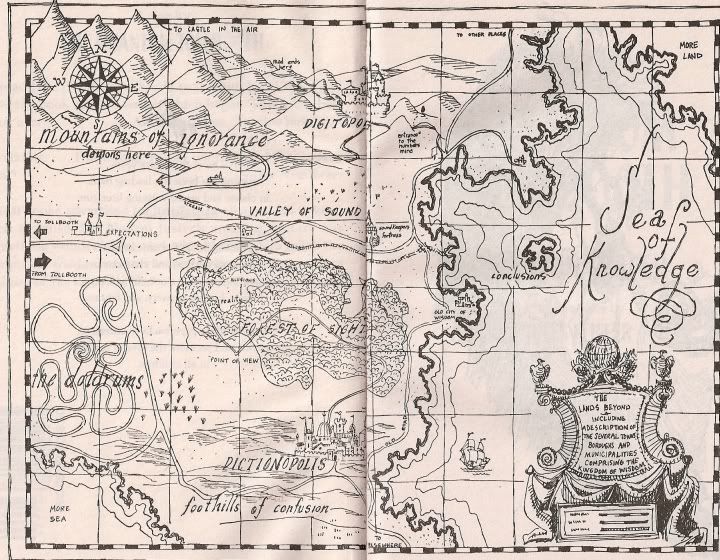
Despite that, I recently pulled my old copy of Norton Juster’s The Phantom Tollbooth off the shelf. I knew some of the wordplay for which this book is justly renowned would go over Dash’s head at this point, but I thought the light, offbeat tone of the narrative would fit his sense of humor pretty well. (Plus there are all those great Jules Feiffer illustrations, which I knew he’d enjoy.) But as I opened it, I tried to remember when Tollbooth had become a cherished book for me. I couldn’t remember the precise age, but I was definitely a good deal older than five.

Still, the book wasn’t a failure with Dash by any means. We read it over several nights of bedtime reading, a few chapters at a time, and he was always ready to return to it each night. It did not become one of those sad, rejected chapter books that never get past the first evening or two, and then sit pathetically on the nightstand until I give up and put them back on the shelf. Dash liked the main characters, especially the trusty watchdog Tock, and the quest storyline. He liked the tone and the humor. He liked the book.

But I didn’t sense he was really into the book, not the way I had been. I’d supposedly prepared myself for this, having realized that Dash might still be a bit young for the weightier issues that make up much of the subtext of Tollbooth, or even that the book might not be as much to his taste as it had been for me. And yet...I couldn’t deny that I felt a little disappointment (which I concealed) that he didn’t just lurve it.

Which brings me back to that parental danger sign. There’s a certain hope in all parents, I think, when we introduce something we love to our kids, whether it be a favorite dessert or a treasured movie or book—and, yes, a certain amount of disappointment when they don’t appear to like it precisely as much as we did (or, worse yet, at all!). Mostly, we’re just after that rush that comes from watching our children experience something that blows them away; when we’ve primed ourselves to expect that, it’s disappointing not to get our fix.

But for me, there was something else, too, something a little uncomfortable: I kind of wanted my kid’s approval of my taste. I suppose even that’s natural enough in a way—I feel the same type of disappointment when a friend tells me she loathed a movie I liked and recommended, for instance. But I don’t want to burden my son with that kind of expectation, that kind of pressure to please me. Even though I’m not telling him openly that I really, really want him to like this book, I know he can probably sense it. (More and more, I come to know that kids sense everything.)

Now, I will certainly continue to bring the books and movies and everything else I loved as a kid to Dash’s attention when he seems ready for them (OK, maybe sometimes a little before). But I’m going to try to leave his personal experience of all this stuff in his own hands, and to keep my expectations—well, not necessarily low, but simply out of the equation as much as I can.

And maybe I’ll hold off on reading Philip Pullman’s (brilliant!) His Dark Materials series with Dash until he’s seven. Or at least six and a half.

[Photo: Whitney Webster]

June 15, 2010

Security Blanket: Mini Grey's Traction Man Books

There are some picture books that, I have to admit, I’m eager to read, day or night. I may even be guilty now and then of attempting to influence my son’s decision on a given evening so he’ll choose one of them for the bedtime read. A lot of these are, of course, old classics I love from my own childhood, but a few are new books that the whole family has grown to love together, as corny as that sounds.

Foremost among them is Mini Grey’s Traction Man series. Grey is an established English author-illustrator whose professional training in theatrical design is obvious from her picture-book work, which is clever and dazzlingly imaginative, and we’ve encountered and enjoyed much of it over the years. But we always return to her Traction Man books—Traction Man Is Here! and Traction Man Meets Turbodog—in which Grey makes brilliant use of the popular sentient-toys trope.

They relate the adventures of a multicostumed, literally square-jawed action figure in the exotic locales of its boy owner’s home: The backyard compost heap is recast as a summit to be conquered; the family cat as a fearsome monster to be avoided. All the proceedings are narrated in the third person with the sonority of a serious nature-expedition documentary: “Traction Man and Turbodog are crossing the wastes of the Sandpit. Somewhere under the shifting sands are the ruins of the Handbag. Maybe that’s a corner of it there. The Handbag Dwellers are very shy.” (Said dwellers, of course, turn out to be old lipsticks and mascaras in Mom’s discarded purse.)

Now, it’s enough fun just to read lines like that in the appropriate Shatner-esque tone of voice, and we’ve amused ourselves and our children doing just that countless times. (Perhaps we should be beginning to get a little less amused after the fiftieth time, but we’re not.) What makes these books especially clever, though, and especially delightful, is the subtext: what’s really happening in the household of Traction Man’s owner. In Traction Man Meets Turbodog, for example, the major plot turn comes when Dad decides that the beloved sidekick of his son’s favorite square-jawed action-hero—a worn-out scrubbing brush named, well, Scrubbing Brush—is filthy and unhygienic and must be replaced. He does so surreptitiously, throwing Scrubbing Brush in the trash one night and presenting the boy with Turbodog, a shiny red battery-powered robotic pet for Traction Man, the next morning.

Now, every parent knows this is trouble. But we don’t see the boy’s reaction to this betrayal directly—instead, we get the confused reaction of Traction Man himself, who wonders where Scrubbing Brush has gotten to as he tries to pursue his normal agenda with Turbodog by his side. (In the aforementioned Sandpit, our hero is forced to rescue his new pet when sand gets in his gears, all the while thinking to himself, “Some sand wouldn’t have stopped Scrubbing Brush. Where is Scrubbing Brush?”)

Naturally, before long Traction Man—the worry in his eyes mirrored by that in the boy’s—must go in search of his beloved sidekick. He looks everywhere, asking some cowboy dust bunnies under a bed if they’ve seen his friend, delving far down into the Grand Sofa Canyon, all in vain—until he hears a muffled noise coming from the outdoor trash can (from which, of course, no one has ever returned alive). But Traction Man, nothing if not loyal and courageous, arms himself with a large spray bottle of SuperStrong Germo with Ammonia and climbs in to fight off the evil Bin-Things and rescue Scrubbing Brush.

It’s impossible to read this stuff without a smile on your face, and kids, quickly getting and enjoying the two levels the story is working on, love it too. Better still, Grey’s books never get old; we come back to them again and again to find the same amount of pleasure we had on first encountering them. In fact, the only complaint I can come up with is that there are only two books in the series thus far. So beyond extreme admiration, that’s my message to Mini Grey: We want more Traction Man adventures!


[Photos: Whitney Webster]

June 10, 2010

New Music: Party Like a Twinkle Star

There’s no question children’s music has improved leaps and bounds in the past several years, both in overall quality and in the number of artists of that higher quality. But while it’s great that musicians capable of professional-quality adult rock, pop, and even hip-hop have turned to the grade-school and preschool set, let’s face it: Parents’ gratitude rarely extends to listening to albums full of songs about pirates and bedtimes when the kids aren’t around.

The Bay Area’s Charity and the JAMband get that. Just from the title, you know Party Like a Twinkle Star’s subject matter is unabashedly for kids. And frontwoman Charity Kahn, whose smooth, easy voice sounds like a cross between Carole King and Joan Osborne, has a knack for never forcing things with her lyrics: A simple song about pancake ingredients is a simple song about pancake ingredients, and that’s just fine. More than fine, in fact—it prevents the cloying factor that’s still the bane of so much music for children, even nowadays.

But back to the music for a second: This double album is divided between a disc of uptempo, upbeat songs (the “Party” disc) and a quieter disc of lullabies and ballads (the “Twinkle” disc). On both, the band shows off ability, as well as its multitude of musical influences, which include nearly every major figure in the ’70s and ’80s pop-folk-rock nexus, from Neil Young and Jackson Browne to the Indigo Girls and Joni Mitchell. (There’s even a specific nod to Joni, a rolling anthem on the “Party” disc called “We Are Stardust.”) And despite the lyrics’ firm grounding in kid territory, several of the tracks are complex and surprising enough musically to raise an adult eyebrow or two—the lovely acoustic-guitar riff that anchors “A Little Night Music,” reminiscent of Nick Drake; the charming, catchy Cat Stevens-esque piano dance of “Moon Hug.”

So while the words will always keep you apprised of Charity and the JAMband’s focus on entertaining your children (just from the energy in these tracks, I bet they put on a hell of a live kids’ show), you’ll find yourself enjoying the melodies and harmonies just as much as they do. And, “best of both worlds” high-profile exceptions like They Might Be Giants aside, isn’t that what the new era of kids’ music is supposed to be about?

[Images courtesy of Charity and the JAMband]

June 7, 2010

New Books: A Dignity of Dragons


I first saw the art of Nicoletta Ceccoli in a book given to my older son when he was about three, a tale of what cats do at night called Oscar and the Mooncats, by Lynda Gene Rymond. The story was cute and spot-on for both the age group and Dash in particular (who loves cats), but what struck me immediately was the illustrations: gorgeously textured, slightly surreal paintings whose human and animal faces all had a particular stylized roundness. Ceccoli’s fingerprint was one I knew I’d always recognize.

I kept an eye out for more work by Ceccoli in the American market. (In the meantime, I learned she’s long been well regarded in her native Italy, having won the Anderson Prize there as best illustrator of the year in 2001.) Last year, I ran across How Robin Saved Spring, by Debbie Ouellet, an old-fashioned fable about various animals’ attempts to awaken Sister Spring and prevent Lady Winter from maintaining eternal frost. The story is lovely, but the art again takes it even further; once you’ve read it, you really can’t imagine it being accompanied by anyone else’s illustrations.

Then last month, I got my hands on Ceccoli’s latest work, A Dignity of Dragons: Collective Nouns for Magical Beasts, by Jacqueline K. Ogburn, a list book for early-graders inspired by the question “What do you call a group of unicorns?” Ogburn decided to come up with answers not just for that particular mythological creature, but for a bookful of them from around the world: a grapple of griffins, a flurry of yetis, etc. (It ends with a glossary explaining the background on each.) Every spread features a few of the creatures, grouped by habitat (yetis, abominable snowmen, and Bigfoots get one to themselves) or by region of origin (there’s a Greek page for centaurs, fauns, and minotaurs).

Again, it’s a cute idea for a short picture book—but one that relies heavily, even more than most picture books, on the art. But loosing this master illustrator on creatures of legend is one of those obvious ideas that turned out even better than expected. Untethered to the limits of a narrative, Ceccoli is free to let her imagination run loose, and the stunning results, like all her work, have a look all their own—like stills from a stop-motion animated film by Botticelli. Her human (or, here, partly human) figures have a pensive expressiveness right out of early Renaissance art, and as you study each image you notice that it’s presenting a little diorama. (The helmeted figure—presumably Oedipus outside Thebes—regarding the skeletons at the feet of a sphinx as he prepares to hear her riddle has a particularly wonderful raised eyebrow.) In essence, Ceccoli bestows her own subtle storytelling on a picture book whose inherent structure is without any—which means kids can lose themselves in these images for extended periods, as my five-year-old certainly has. (Click on the image below for a close-up look.)


Even at a more macro level, the art speaks for itself. Open to any page and you’ll see something I don’t think any other children’s-book illustrator could accomplish in the same way. She’s shown in just the three books I’ve read that she can take a good picture-book concept and elevate it to the greatest heights. What higher praise is there for someone in this line of work?

While I await Ceccoli’s next picture book for the U.S. market, I think I’m going to start trying to dig up some of her Italian work.

[Photos: Whitney Webster]

June 5, 2010

New DVDs: Where the Wild Things Are


If I’m honest, I have to admit I was resisting the movie of Where the Wild Things Are, the DVD of which is really only new-ish by now. Maurice Sendak’s classic picture book holds an especially dear place in my heart, both from my own childhood (I think Sendak, like Mr. Rogers, will always be a touchstone for our entire generation) and as one of the first favorite books of my older son. I’d heard all the good things, including the author’s own enthusiastic endorsement of director Spike Jonze’s interpretation; I’d seen the stunning previews.

Actually, the previews may have been part of the problem, because they revealed the introduction of a backstory to Max’s escape. While I recognize the necessity of such things when you’re turning a 48-page picture book into a two-hour movie, it still worried me: I really didn’t want to see Sendak’s wondrous dreamscape reduced to a banal pop-psych explanation—a kid upset with his mom for having a boyfriend. So we never did make it out to see the movie when it was in theaters.

But when we realized last weekend that we’d put off seeing How to Train Your Dragon in theaters until it was no longer in any local ones (the closest apparently being 3,000 miles away in Anaheim, California, by that point), we had to manage Dash’s disappointment somehow. Remembering that I had finally allowed Where the Wild Things Are to reach the top of our Netflix queue, I grasped the opportunity it allowed us: to rescue our all too vaguely planned Friday movie night.

I soon discovered that my main concern was overblown. The focus of the film is firmly on Max, and what’s going on inside his head, throughout; while everyday family strife (an inconsiderate older sister; a beloved but busy mom played by the wonderful Catherine Keener; and, yes, the disliked boyfriend) does fuel his wild behavior, it's dealt with quickly, and we’re off to the land of the Wild Things in fairly short order. (I am not normally happy to see Mark Ruffalo reduced to a couple of minutes of screen time, but since he played the boyfriend, this one time, I was.)

There, he meets the remarkably dysfunctional Wild Things, who include the sad, sensitive, but violent Carol (voiced by James Gandolfini); Judah (Catherine O'Hara, brilliant as ever, even just as a voice), the self-described “downer” I'd describe more as a kvetcher; and Alexander (Paul Dano), the mopey one who complains (accurately) that no one listens to him. They are about to eat Max when he saves himself by claiming he is a king, and should be theirs. Desperate for leadership, for someone who can make sense of their world for them, they quickly agree enthusiastically, at which point the famous “wild rumpus” does indeed start. Of course, after auspicious beginnings, Max cannot possibly live up to the group’s expectations of him. Soon enough, they discover he’s not a king, and in fact is just like them: unsure of himself; frustrated and often bitterly angry that things never quite turn out as one hopes they will; disappointed in others and in himself.

We’re on pretty existential ground here, you’ll notice. Which is all very well for adults, for whom the movie works well, for the most part, as a poignant look at the frustrations of being a kid in a world that’s often disappointing and confusing. But this brings me to the other reason I think we never made it to the theater last year to see this: Who’s the movie for? Is Where the Wild Things Are a kids’ movie? I wasn’t sure back then, and now I see why: I don’t think it really is.

Mind you, there’s nothing objectionable, or really frightening, that makes it explicitly not a kids’ movie, either. It held Dash’s attention all the way through, and he enjoyed it well enough. But most of the heart of the film—the existential angst, if you will—went right over his head; he’s just too young, thankfully. When he experiences the feelings of frustration that this movie is about, he just gets angry, as Max and Carol do in the film. He doesn’t get wistful or sad, or start reflecting on the imperfections of existence.

So I'm pretty sure Where the Wild Things Are won’t be one of Dash’s go-to DVDs, one of the ones he watches over and over. Based on his initial reaction, I'd be surprised if he even wants to see it a second time. In its way, it’s like the opposite of a non-Pixar animated film: a film for adults that the kids will be happy to sit through. (I suppose you could say it’s about time we had one of those!)

One last thing: Visually, the film really is astonishing, and I’m sure that fact would play a far larger role in my writeup than it has, had we seen it in the theater. It still comes across at home (on a normal-size screen—we haven’t gone to the giant TV yet), but you simply appreciate the beauty; it doesn't blow you away, as I suspect it might on the big screen. So after all my hesitations and caveats, I kind of do wish, now, that we’d gone to the theater to see it!

[Photo Courtesy of Warner Bros. Pictures]

June 2, 2010

New Games: Woody’s Run-Around Roundup


The San Francisco–based toy and game company Wild Planet has a niche to itself, comfortably between the designers of expensive, high-end tech-y toys you’re afraid to give your young kids for fear they’ll break them, and the producers of cheap, disposable toys you expect your kids to break instantly. Its products are well-made enough to last a while under the high stress our kids put toys through, but also generally come in at a reasonable price point. I’ve long been a fan of the company’s remote-control SpyGear vehicles, several versions of which—it can now be told—terrorized the halls of the Cookie art department a few years ago. (The responsible party or parties remain at large.)

Parents will also appreciate the Wild Planet’s focus on active games for pretty much all ages—most welcome when you’re trying to find ways to pry your children away from DVDs for an afternoon or two. Its latest of these is Woody’s Run-Around Roundup, branded to the upcoming Toy Story 3 movie. The game features five pieces: one large handheld “tagger,” shaped like Woody from the movie, and four character “targets,” in the form of Buzz Lightyear, Jessie, Hamm, and Rex. The tagger shouts out  instructions (in Woody’s voice), telling a player to tag the character whose name begins with R, for instance, or the one wearing a white spacesuit; that player must then “tag” the correct character with the Woody figure to advance to the next question. (Embedded microchips allow the “tagger” to recognize automatically when someone has made the right or wrong call and respond accordingly, with either encouragement to try again or a new character to tag.)

The game has several modes—solo and multiplayer timed games, in which you’re trying to get through a set number of questions in the fastest time; a memory game, in which you have to remember a sequence of challenges as it builds up; and a hide-and-seek treasure-hunt game. You can set up the four target characters just about anywhere kids can get to, and thus make the timed games quite exerting in a decent-size backyard—but the games can also be played indoors on a rainy day, in one room or spread throughout a house. Parents can join in and play with the kids (depending on how much sleep you’ve been getting, you may or may not have to ease up on them) for a whole-family game, but it’s also simple enough for kids age three and up to play on their own. In short, you have lots of options.

And if you’re not into the branding (which in the case of my son did provide a little extra help in getting him away from the TV), never fear: This is in fact a variant on a previously existing Wild Planet game, Animal Scramble, in which the characters are simply various animals—a monkey, an elephant, a giraffe, and so on. (Both the branded and unbranded versions require three AA battteries.)

It’s not super-high-tech, but all in all, you and your kids end up with quite a lot for your 25 bucks or so. Which is precisely what I’ve always appreciated about Wild Planet.

[Photo courtesy of Wild Planet]

June 1, 2010

New Books: Farm


I wrote recently about how you know at first glance sometimes that a picture book might be special. Well, in some cases, you don’t even need the glance: when you’re already familiar with the author's work. My first exposure to writer-illustrator Elisha Cooper’s work was his lovely 2006 picture book Beach, which takes the reader through a full day by the shore. Somehow managing to be macro (evoking the feel of a lazy beach day) and micro (including pinpoint details like sandy toes and beach balls floating away) all at once, the book was a revelation to me—at only two years in to parenthood, I hadn’t yet discovered the joys of the contemplative children’s picture book at the time. 

So when I saw that Cooper had come out with a new book earlier this year, Farm, I was eager to see what he'd done with another subject. The look and feel here are similar to that of Beach: calm, reflective text accompanying beautifully clean watercolors, which in this case portray a full year in the life of a typical American farm. As in his earlier work (which does in fact long predate Beach, my earlier ignorance notwithstanding), Cooper matches the quiet charm of his illustrations with the placidity of his simple, to-the-point sentences, which often have the feel of a children's book by Ernest Hemingway: “It starts to rain. The tractor stops again. March is a mud month and weather must be dry for tilling. The farmer will have to wait. Weather can’t be fixed.”

Again, the author proves expert at both detail—the names and character traits of the individual cats who live on the farm, say—and the big picture, so to speak: the seasons changing, and the world of the farm passing from one to the next in sequence. This all makes the book good as a bedtime read, certainly, but even better for a child to leaf through slowly at his or her own pace and leisure. (That's pretty much what an adult will want to do with the book, too.)


And since he’s more than delivered on the promise of his previous work here, I’ll look forward to Cooper’s next picture book even more eagerly. Happily, I see it’s not that far off now

[Photos: Whitney Webster]

May 27, 2010

Life During Naptime: Tiny Art Director


While I promise to always concentrate on the kids’ entertainment that’s the nominal focus of this blog, from time to time I see something aimed at a parental audience that I can’t resist typing about. The first such entry is a humor book for parents that came out a couple of months ago: Bill Zeman’s Tiny Art Director: A Toddler and Her Vision.

I was at a nexus of parenting and graphic design for nearly four years at Cookie magazine, so it’s sort of shocking I’d never run across the blog from which this book is drawn. In it, artist Zeman has been relating his (largely unsuccessful) attempts to fulfill the drawing requests of his young daughter, Rosie. (She was two years old when he started; now she’s five.) On the other hand, I’m now sort of glad I hadn’t found it earlier, because I think I had the chance to appreciate the book, a collection of some of Zeman’s best and funniest entries, all the more.

From all other indications, Rosie seems a lovely little girl, but in her assignments to her poor father and her reactions to his “submissions,” she is a true tyrant, of the kind every artist on assignment must dread: She changes her mind midstream. She flatly contradicts herself on precise details of her original requests, denying she ever made them. She completely forgets what she’s asked for seconds after she’s asked for it. She yells and demeans his talent.

Having now gone back to see the original blog, I also have to say the book’s format, if anything, makes things  funnier. Each spread contains “the brief” (Rosie’s original request) and the drawing Zeman has created from it on the left-hand side, and the “critique” (her reaction to the finished work), along with a stamp of approval or rejection, on the right. (I’d say the rejected-to-approved ratio approaches 20 to 1.) And while Rosie’s behavior is perfectly familiar to parents who’ve lived with kids this age, the “art director” frame has the wonderful effect of making her seem borderline insane—similar to the supremely wacked-out bosses on some sitcoms. The cumulative effect is laugh-out-loud funny, and pretty irresistible.

A typical example: Given the brief “A ‘C,’ an ‘H,’ and a dinosaur mouth”—for which, Zeman notes, requests for any further clarification from Tiny Art Director were denied—the artist pens a green T. rex in profile, with the two letters in his open jaws. Tiny Art Director’s critique: “NO!!!! CH and a mouth! I hate the mouth and the teeth.” An artist’s statement follows: “I never did find out what the heck this was all about.” Below, another:


Postscript: Tiny Art Director is clearly aimed at adults, but my five-year-old got curious about it while I was checking it out, and soon became fascinated himself—though on a different level, it seemed. He wasn’t laughing at the humor, just checking out the drawings. I was wondering whether he was getting the concept at all when he walked over to me with the book and, pointing to one of Zeman’s rare approved drawings, said with a beaming smile, “Look! She liked one!”

[Photos: Whitney Webster]

May 26, 2010

Kindiependence Day


Seattle, known since my own youth for its independent music scene, now also has a thriving music scene for youths. Now, I don’t really know that I have a huge audience in the Pacific Northwest at this point in my blogging career, but I have some news that any parents in the vicinity, whether visiting or native, should know about.

Several of the city’s leading kids’ bands recently joined forces in a collective known, fittingly enough, as Kindiependent. And four of them will be performing together in a free family concert, the Share the Music Festival, in Seattle’s Freeway Park (700 Seneca Street, corner of 7th and Stewart) on Sunday, June 13, from 12 to 2 p.m. 

I’m most familiar with the work of two of the bands in Kindiependent that will be playing the festival, Recess Monkey and the Not-Its, and I’d include both among the highest echelon of today’s makers of music for children. A free concert featuring both, as well as more of Seattle’s leading lights of the genre, is well worth parents’ attention. The concert will also celebrate the release of Recess Monkey’s sixth CD, The Final Funktier—and watch this space in the coming weeks for more on that album, by the way.
[Image courtesy of Kindiependent]

May 25, 2010

New Books: Mama, Is It Summer Yet?


Sometimes you can tell almost at first glance when a picture book is going to be special. Usually the art is the driving force—so gorgeous, so unique, that it immediately separates the book from the pack. There are times when, on cracking the cover, I discover with disappointment that the storytelling isn’t up to the illustrations’ standard. But more often than not, the beauty is enough to carry a simple tale for the required duration. The best recent example I can think of is The Lion and the Mouse, by Jerry Pinkney, a completely wordless masterpiece that won the Caldecott this year; it’s probably my favorite children’s book to have come out since I’ve had kids.

I recently saw another book that enters this rarefied air, one that has made me wish I’d started this blog a little earlier, so I could have featured it in time for Mother’s Day: Nikki McClure’s Mama, Is It Summer Yet? Its call-and-response-style text alternates between a boy asking the title question during the months before summer and his mother’s various answers (e.g., “Not yet, my little one. But the buds are swelling. Soon new leaves will unfold.”), until summer finally arrives on the last pages.

But the art…the art! McClure’s dazzling illustrations, as she explains in an author’s note at the end, are made of cut paper: The self-taught artist drew images on black paper, then cut them out with a knife to create lacelike images. The result is truly arresting, like folk art depicting modern scenes, vaguely reminiscent of some of Maurice Sendak’s early work. The effect, in combination with the unaffected words, is nearly hypnotic, evoking a sense of peace and calm.


So while I may have missed Mother’s Day, I can still wholeheartedly recommend Mama, Is It Summer Yet? as an excellent bedtime read for the little ones (and perhaps even slightly bigger ones—our five-year-old was quite taken with the art) in your household.

Update: I was so forlorn about missing the holiday, I neglected to note that the subject matter remains quite a propos for the season!

[Photos: Whitney Webster]

May 23, 2010

Old School: '80s Summer Movies for Kids


A friend writing a story about a backyard movie party asked me the other day for some good “summer movie” recommendations for kids—that is, our generation’s summer movies (i.e., from the 1980s) that are kid-friendly. The key being that they should be enjoyable for kids and parents alike, and the parents get a little bonus nostalgia in the bargain.

Having no shortage of opinions, and happy to get a chance to broaden the blog’s horizons beyond what my own kids watched or read last night, I jumped at the chance. Without further ado, my picks, divided by age suitability (one caveat there: my age ranges push the envelope a bit, under the theory that that’s what kids always want to do):

AGES 5 AND UNDER
Safe choice: The Muppets Take Manhattan (1984)
The gang does the old “let’s put on a show” bit, which may sound predictable enough, but did you expect Kermit to get amnesia and think he’s an ad exec named Phil? Probably the best of the Muppets films, and a real crowd-pleaser.

Adventurous choice: The Princess Bride (1987)
Some potentially scary moments here for little ones—the Pit of Despair, the Rodents of Unusual Size—and it also works for the next age group up. (Heck, any age group—I admit it, I still stop and watch it on TBS half the time.) But my five-year-old has adored it since age three, and it’s the kind of movie that’s a particular thrill to watch kids watching.

Nonobvious choice: Wallace & Gromit in Three Amazing Adventures (2001)
I’m kind of cheating here, only justifying this choice by the fact that the first W&G short, A Grand Day Out, was made in 1989. But like all Nick Park’s work, it and the other shorts here (Oscar-winners The Wrong Trousers and A Close Shave) are endlessly entertaining adventure tales—so even if these are not strictly summer movies, they fit seamlessly in with the theme. 

Other options: Pee-wee’s Big Adventure (1985), Follow That Bird (1985)

AGES 6 TO 8
Safe choice: E.T. (1982)
“Safe” is a relative term, since as we all remember, this is a serious tear-jerker. But it’s safe to say it’s a classic most kids this age will be thrilled by, especially en masse. Enjoy the blank looks when you tell them the little girl voiced the female lead in the recent Curious George movie.


Adventurous choice: The Dark Crystal (1982)
Normally the Henson movie with puppets wouldn’t be the risky call, but this is a seriously dark fantasy, about the last of the Gelflings and his quest to end the rule of the evil (and scary!) Skekses. If your audience frightens easily, this may not be the right pick—but if they’re into fantasy lit or graphic novels, it could also be a huge hit.


Nonobvious choice: Labyrinth (1986)
Henson again (live-action this time), but I couldn’t resist David Bowie in tight pants. It’s actually a twist on a really old story: the Goblin King (Bowie) kidnaps Jennifer Connelly’s little brother when she complains about having to take care of him, and she must grow up a bit and use her all her wits to get him back. Extra points for any kids who can figure out which voices are done by Elmo.


Other options: The Last Starfighter (1984), The NeverEnding Story (1984),  Short Circuit (1986), Willow (1988)

AGES 9 TO 12
Safe choice: The Goonies (1985)
I was 15 when it came out, the perfect age to resist this movie, and I did. (Happily, I caught up with it some years later.) For kids a bit younger, though, the rollicking tale of a bunch of kids on an adventure to find pirate treasure is well-nigh irresistible. And it’s packed with nostalgia-inspiring actors, from the firmly-of-the-era (Corey Feldman) to recent and current stars (Sean Astin, Josh Brolin, Joey Pants).


Adventurous Choice: Ghostbusters (1984)
I suppose you can see it every weekend nowadays if you don’t mind sitting through the ads, but it’s hard for me to think of a movie that would amuse and thrill a group of kids and parents more. I seriously doubt it’d be just PG today—there’s lots of swearing, some sexual innuendo, and a bit of scary ghoul stuff—but for kids who are up to it, that’ll just make them love it all the more. Meanwhile, you get to watch a Bill Murray/Harold Ramis movie. It’s win-win!


Nonobvious choice: The Bad News Bears (1976)
All right, it’s not from the ’80s, but it’s certainly a gen-X movie. (Let’s just agree not to discuss the recent remake.) Walter Matthau will keep everyone entertained as the former minor-leaguer forced to coach the saddest Little League team ever . You may pause to marvel at how the definition of a “kid movie” has changed—there’s even more “objectionable” language and behavior here than in any other movie I considered—but you’ll be caught up in the next laugh before you have much time to ponder it.


Other options: Raiders of the Lost Ark (1981), Clash of the Titans (1981), WarGames (1983), The Karate Kid (1984), Gremlins (1984), Back to the Future (1985)

In parting, let me add that when it comes to movie nostalgia from this era, I always lean heavily on Cinema du Meep, a blog well worth checking out for the obscure and the sublime in 1980s (and many other) flicks.

[Photo: Chad Davis, via Wikimedia Commons.] 

May 21, 2010

Security Blanket: They Might Be Giants


Most parents probably don’t need me to tell them They Might Be Giants make fantastic music for kids, so consider this more of a gratitude post. Because my wife and I honestly turn to each other from time to time and ask what we’d do without TMBG’s four children’s albums.

The miracle their music has achieved in our household can be explained in terms of a particularly vicious cycle: The more appealing a CD is to your kids, the more your kids want to hear it—usually on endless loops that last days. By the end of these loops, it often doesn’t matter what you, the parent, thought of the music to begin with. You now wish to never, ever, ever hear it again. (I mean, there’s not an awful lot of adult music that could stand up to 36 consecutive plays.)

Yet somehow, Johns Linnell and Flansburgh have created not just one but several albums that our sons can’t get enough of—and that we still enjoy hearing ourselves. Now, this is doubtless in part because both Whitney and I were album-owning fans of their adult music years ago, and because TMBG is the rare crossover-to-kid-music group whose sound—and lyrical cleverness—didn’t change one iota in the transition. (Indeed, TMBG still records adult albums, and tours them.)

However, there’s still something remarkable in the fact that I was recently at work humming “Meet the Elements,” off the Here Comes Science CD, and not only did I not start screaming in horror once I realized this fact, but I smiled and kept humming. (And before you pawn this off as parenting-related psychosis, let me assure you this is not my reaction when I catch myself singing the theme to “Elmo’s World” in the supermarket.)

That would be enough to be thankful for, but TMBG delivers more. The animated videos to their kids’ songs, many delivered originally in a series of weekly podcasts, delight Dash and Griff even more than the music alone does. They’ve proved invaluable, in more than one desperate moment, as short-term YouTube babysitting. And again, parents will find themselves being sucked in to watch the clips themselves at times. (This does admittedly reduce the babysitting value, but I have no one to blame but myself.)

On top of all that, we realized as we heard Dashiell singing “Roy G. Biv” the other day that, thanks to John and John and their band, he was…well, actually learning some things about the color spectrum. Education had honestly never occurred to us as a potential benefit of any children’s album, since most attempts at it are heavy-handed and, well, no fun. But TMBG’s songs—especially those on the science album, their most recent for kids—do what educational entertainment always tries but usually fails at: They make learning fun, so much that it doesn’t really seem like learning. 

So for all that—but mostly for the nonsuicidal parenting part—we thank you, John and John.


May 18, 2010

New Books: Palazzo Inverso


Conceptual picture books—by which I mean ones that operate more from a particular theme or idea than in a traditional linear narrative—are funny things. Some of them, even the most beautifully thought-out and magnificently illustrated ones, fly right over the heads of their intended audience. With others, kids get the idea behind the book immediately and soon share its author’s fascination with the subject matter.  Of course, taste is also involved; as always, the book your kid likes may put mine to sleep. (Though I may want that book anyway...) But the very best concept books have universal appeal.

Palazzo Inverso, written and illustrated by D. B. Johnson (who’s perhaps best known for the Henry series of children’s books), introduces children to the mind-bending work of M. C. Escher—all those visual images that turn in on themselves, using tricks of perspective to create scenes that would be impossible in three dimensions. A quote from Escher himself on the back jacket provides a sense of what’s inside: “It is impossible for the inhabitants of different worlds to walk or sit or stand on the same floor.... Yet they may well share the use of the same staircase.”

The book tells the tale of Mauk, an architect’s apprentice trying to figure out what’s gone wrong with the palace his master is building—why the builders are be spilling bricks up to the ceiling, for instance. Mirroring the boy’s own perceptions, the text starts out flowing in normal, linear left-to-right fashion, but there’s also text upside-down at the top of each page. At the “end” of the book, right as Mauk figures out what’s caused the strange occurrences, the text continues around to that upside-down text; you flip the book over and continue reading back the other way. In a clever narrative use of the classic Escher effect, the same images you’ve seen going in one direction serve slightly different purposes on the way back. (It’s at this point that I noticed that the text of each spread of the book functions as its own complete loop, as well.)

Johnson’s illustrations do great justice to their inspiration, combining the familiar color palette of much of Escher’s own work with a softness that adds to both the mystery and the beauty of the pages. But of course, it’s the dual nature of the images themselves that will most fascinate many kids—it was a bit of a thrill to watch my five-year-old see these types of illustrations for the first time and try to get his mind around what was happening in them.

The looping effect of the text does make this book a bit risky as a bedtime read—you could get stuck in this Palazzo a lot longer than its 32 pages of minimal text would suggest, especially if your child is mesmerized by her first exposure to Escher. But that just shows it’s a picture book a kid can get lost in, and I think many will spend a lot of time examining, and pondering, Johnson’s work.

[Image: Courtesy of Houghton Mifflin Harcourt.]

May 17, 2010

Real Wild Child


After we became parents, we kept listening to “our” music with our son around without a second thought. Sure, we worried now and then about “explicit lyrics,” but c’mon, we’d been scoffing at those labels since Tipper Gore introduced them when we were kids! We weren’t going to shelter Dash. 

Time went by, and now Dash could talk and was asking for Iggy Pop by name. Still, we convinced ourselves he wasn’t listening that closely to the lyrics of “Lust for Life” and wouldn’t be asking us what a “flesh machine” was for years yet. Heck, the song was being used on TV commercials for family cruises—it was obvious that only we and Iggy, and perhaps David Bowie, even knew what the lyrics were saying.

By this time, Dash’s favorite album to listen to in the car was by the Pogues (whose very name was only unobjectionable because he didn’t know the language it was objectionable in); his favorite song on the album was the rollicking “Streams of Whiskey.” It only dawned on us gradually that this might get some surprised looks should it come up in preschool. 

So what to do? We didn’t want to suddenly become hyperconservative on the subject, but we also didn’t want Dash’s preschool teachers asking us why he was teaching his classmates the lyrics to Nine Inch Nails’ “Closer.” (Before you call child services: No, we never really let him hear that one.) We figured there were only a few options:

1. We could lie. Dash mangles lyrics regularly, so we could try to convince him that the “flesh machine” Iggy was singing about was...um, a robot! Or, alternatively, that he wasn’t saying “flesh machine” at all, but “flash machine.” (He’s just talking about his camera!) Problem is, these lies would eventually be found out, and there’s going to be enough hell to pay when the Santa Claus chickens come home to roost. (Plus we’d still have “liquor and drugs” and, oh, most of the rest of “Lust of Life” still to explain away. Seriously, how did this song get picked up for those Royal Caribbean ads? Did someone confuse the different meanings of “cruising”?)

2. We could pull the music—the Pogues and Iggy and Parliament/Funkadelic and the rest of them—out of rotation. We didn’t like this one much either. To take the selfish point first, this would mean we could never listen to any of this music ourselves with the kids around. Beyond that, though, we kind of believe in letting our kids hear good music, you know? According to renowned parenting authority Lou Reed, you can hear the music that saves your life at just five years old. (Let’s just ignore Dr. Reed’s attitude toward parents in that song for the moment.)

So we went with a third option: puttering on as we had been, with perhaps a little more attention to the issue. We don’t actively prevent anything objectionable from reaching our children’s ears, but in cases where it’s just as easy to play something without references to heroin, we do that. If they hear something they “shouldn’t” and ask about it, we explain as honestly as we can under the circumstances. 

And since Dash seems to handle hearing a really appalling amount of adult cursing without engaging in nautical language at school himself, we have faith that he’ll know it’s not appropriate to discuss the oeuvre of Prince in that venue, either. Our laissez-faire attitude may yet come back to bite us someday, I suppose, but we’re not that far from the time when we’ll be losing our absolute control over the music Dash hears anyway. (Or so I rationalize.)

We’re also finding, however, that our own terror of awkwardness breeds vigilance. Dash’s current favorite adult song is Pete Townshend’s “Let My Love Open the Door,” off his Empty Glass album. Perhaps he would have preferred the opening track, “Rough Boys,” if I’d let him hear it, but once I started picturing myself trying to explain leather bars, I hit “skip.” 

As in so many facets of parenting, training your kids really means training yourself.


[Photos: Masao Nakagami (McGowan); elekes (Iggy). Both via Wikimedia Commons.]