Search This Blog

July 30, 2010

New Toys: MoMA Modern Playhouse


Playhouses come in many styles and formats these days. There’s the colorful plastic Fisher-Price ones that haven’t changed all that much since my own childhood; there’s the many fabulously details options from Playmobil; there are even a few high-end ones made from recycled materials or lovely wood.

What I hadn’t seen till now is a design-oriented playhouse at a modest price point—but that’s precisely what the MoMA Modern Playhouse is. For $20, you get a smartly designed box that holds all an kid-aesthete needs to create his or her own modernist pad. The box itself, and a few smaller ones inside, serve as walls in various colors and simulated textures (brick, stone, a few different painted plaster options). Also inside are three reversible floors and floor coverings (rugs, wood flooring, and even grass or a small pool if your child is designing the patio); a set of punch-out cards of hip furniture (older kids can put it together themselves; younger ones will need a more dextrous parent’s assistance with the folding and inserting); and a panel of endlessly reusable plastic-decal home accessories (lamps, plants, clocks, etc.) that can be attached to the walls anywhere that seems pleasing. 

Considering how compact the outer box is—about half the size of a standard lunchbox—the variety inside is remarkable: The possible permutations are nearly endless. (For the slightly less minimalist child who wants his playhouse inhabited, there’s even an add-on Modern Play Family kit of press-out people with vinyl clothes; it is, in the age-old phrase, “sold separately.”)

Now, many design-y toys are great if you’re, say, Frank Gehry, but can be disappointing to less precocious children, who get frustrated at their failure to approach the gorgeousness on the front of the box. That’s not a problem here—it’s incredibly simple to put together something that looks pretty great. (Since my own design skills are only barely at the pre-K level, the proof is in the photos below. As I always say, if I can do it, a six-year-old can, too. I did need to adjust that lamp a bit, though, I now see....) It does, however, probably take a child with at least occasional tendencies toward stillness to really enjoy this product, and not to accidentally destroy it: While the whole thing is remarkably sturdy given the materials, we’re still talking about cardboard and thick glossy paper here.

Kids with an eye for design, a decent imagination, and some semblance of motor control will get a lot of enjoyment out of the MoMA Modern Playhouse. It’s pretty dreamy for parents, too—one of those toys that actually looks good when a kid forgets to put it away when she’s done. And when she remembers to tidy it up (or you just do it—let’s be realistic here), everything fits nicely back inside the small box—so the playhouse is also perfect for travel, though I’d probably avoid the beach given the materials it’s made from. So the playhouse hits the parent trifecta: Nice to look at, versatile, and reasonably priced. (Seems like a pretty good gift option as well!)


[Box image courtesy of Chronicle Books]

July 28, 2010

New Books: The Amazing World of Stuart

I can’t say I was all that focused on children’s books before our first child was born in 2004. So my knowledge of the field since my own childhood, but prior to that year, has been largely limited to what’s already made the canon—Mo Willems, and that Harry Potter guy, say. I often wonder what I (and thus my sons) have missed out of sheer ignorance.

Libraries are one solution to the problem, of course, and we’ve made many discoveries from those distant 1990s there. Another is recommendations and gifts from friends who have older kids or better research talents; favorites like Peter Sis’s Madlenka and the previously mentioned Who Needs Donuts? came via that route.

But publishers are doing their part to further my education as well, and a recent reissue just became the latest passion of my five-and-a-half-year-old. The Amazing World of Stuart is simply two short books in one volume: Stuart’s Cape and Stuart Goes to School. They came out in 2002 and 2005, respectively, and were written by Sara Pennypacker, an author I was in fact familiar with (via her sublime Pierre in Love). I was, however, completely unfamiliar with the Stuart books.

Each of these two short chapter books is, of course, about Stuart, a young grade-schooler who’s just moved to a new town and is about to start at a new school. He is a worrier, obsessing about all the things that could go wrong as a new kid in a new place. Luckily, he’s also imaginative, and he uses his powers of invention to both avoid and (kind of) face his troubles, real and imagined.

The trick of the books, beyond Pennypacker’s endearingly wry tone in general, is that there’s no change in the narrative when Stuart’s imagination takes over. When he designs a magic cape and is subsequently visited by three wild animals, who inform him that he’s been playing “wild animal” all wrong and then take a turn at playing Stuart themselves, it’s really happening, as far as this book is concerned. The noise in Stuart’s closet that his parents yell upstairs to complain about? It wasn’t Stuart—it was the bear. Honest.

Pennypacker weaves this kind of fantasy through the reality of Stuart’s first days in his new town (during which he also starts flying all of a sudden, and later finds that his pet cat has switched places with the local garbage man, all thanks to the magic cape) and first encounters at school (which include an adventure with portable holes that’s reminiscent of the late Heinz Edelmann’s work on the Yellow Submarine movie). In Stuart himself, she’s created a neurotic go-getter, a seeming oxymoron that’s actually a pretty realistic portrayal of a certain type of 10-year-old. It’s all delightful, and Dash was hooked immediately; this was one of those “let’s read it again” books from the start.

Not that this is the main criterion I use for kids’ books, but The Amazing World of Stuart is also stunningly inexpensive, even for a fairly thin paperback. I’m unused to paying less than $5 for just about anything that gives either of my children this much pleasure!

[Image courtesy of Scholastic]

July 26, 2010

Old School: The Cricket in Times Square


I always kept five or six of my favorite childhood chapter books on my shelves, all the way through adolescence and young adulthood and marriage. I was never entirely sure why, other than my general reluctance to get rid of, well, anything. (Yeah, I’m one of those.) 

So for all those years, there sat George Selden’s The Cricket in Times Square next to the Sartre play (yeah, I’m one of those, too). It was my very first favorite chapter book—to a kid growing up in a still-gritty Manhattan, Selden’s classic about an out-of-town cricket who becomes the toast of New York City and saves the family newsstand of the boy who befriends him had a comforting familiarity. Heck, two of the three main characters were New York City archetypes, seen on a daily basis in my Upper West Side existence. It’s also not a classic for nothing; the story itself, while undeniably dated in certain ways, is a true kid’s page-turner.

The book was originally published in 1960, and is set in what was, I now realize, a very different city than the one I was living in about twenty years later. But there were enough touchstones in it for me to recognize my city, too: The teeming insanity of the Times Square subway station hasn’t changed that much even now, even if the layout has, several times. More than that, though: Selden’s writing itself has a timeless quality, especially in his portrayal of his lead characters. If you’ve spent any time in New York, you’ve almost certainly met a Tucker Mouse or twelve, and you’ve probably encountered a few Harry Cats as well.

So the first moment I thought there was even a prayer of his having the slightest interest, I introduced my old, tattered paperback copy (the price on the cover: 95 cents!) to my older son’s bedtime reading. It was his first chapter book, and it was really way too early. I don’t think he was three yet, and while The Cricket in Times Square does feature many wonderfully vivid illustrations by the great Garth Williams, they are occasional, not ubiquitous—it’s a chapter book, not a picture book. But as ever, I couldn’t hold myself back; worst-case, I figured, we’d give it a shot, he’d be bored, and we’d stop.

We didn’t stop. Dash loved the book from day one, and became pretty obsessed with it for about a year. It inspired some of his first playacting, involving both scenes from the book—the fire in the newsstand was a favorite—and ones of his own invention, using Selden’s characters. (Dash was always Harry, while his mother and I traded, in repertory, the roles of Tucker and Chester Cricket.) At bedtime, we would read it over and over again, until my already old and fragile edition began to fall apart. Once, during a visit to my office in Times Square, Dash wanted to go down to the subway station to see Mario’s newsstand and Tucker’s drainpipe, and was nearly inconsolable when I informed him that the station has changed since that time (well, it has!) and so we probably wouldn’t be able to pinpoint their exact locations.

In summary, my first favorite chapter book became Dash’s first favorite chapter book. And yeah, I probably did force the issue a little, but it was still pretty heartwarming.

That isn’t the end of the story, though. The Cricket in Times Square turned into the gift that kept on giving in our household. First there were Selden’s own sequels, of course, which I’d read myself as a child. But then, just as Dash’s interest in the books was beginning to lose some of its heat, I discovered an audiobook version, read by actor Tony Shalhoub (of the TV show Monk and many films, including Big Night). It’s a fabulous rendition, among the best children’s audiobooks I’ve encountered; Shalhoub captures each character brilliantly with his voice work. Dash was hooked anew. (Plus, now we had a new fail-safe tool for long drives and plane rides.)

A bit later, I found (courtesy of my former colleague Christopher Healy) a Chuck Jones Collection DVD that includes a 1973 animated short of The Cricket in Times Square by the animator, as well as two odd but entertaining holiday-themed sequels that use Selden’s characters. The immortal Mel Blanc provides Tucker Mouse’s voice for all of them, which demonstrates just how spot-on Jones and his team are with their adaptation. (The DVD is advertised as featuring several stories from Kipling’s The Jungle Book, also well worth seeing.)

At five-and-a-half, Dash still loves every version of The Cricket in Times Square—books, audiobook, videos—and comes back to each of them often. (Though it does seem to be time for a new edition of the book, as pages are starting to fall out and go missing!) Which means, now that I think on it, that The Cricket in Times Square has been among his most treasured books for more than half his life. And, alarmingly, more than three quarters of mine.


[Photos: Whitney Webster]

July 22, 2010

New Games: Loopz

I remember my own parents looking at the early-computer-technology games I had when I was a kid and commenting, a little uncomfortably, about how much games had changed since their youth. Of course, they were talking about Mattel Electronic Football and Merlin, so by now I know exactly how they felt.

But every now and then I see a toy or game that magically melds parental nostalgia with somewhat more modern technology. Mattel’s new Loopz has something in common with one of my generation’s old favorites, Simon, but—as a good modern toy should and must—goes way beyond it, too. In several different directions.

As you can see in the image above, Loopz looks sort of like a set of plastic horseshoes stuck together (well, plastic horseshoes from the rec room of the starship Enterprise). Within each of the four arches—I suppose I should really call them “loops,” huh?—there’s a pair of small sensors, one at the top and one at the bottom. When you break through the invisible line between them, you trigger a light and a sound. (After a little practice, I found that the most effective and efficient way to do this was to stick my hands in each arch with a little lift, like a magician or someone playing water glasses. That may just be me, though...the chipper kids in the demos on Mattel’s site use a more direct style.)

That’s the basic concept, but Mattel has found a variety of ways to turn it into game play and ... just regular play. The first is the old Simon one, a memory game: Loopz plays an ever-increasing series of sounds and lights, and the player has to repeat after it. Then there’s a reflex game, in which you try to put your hand in the loop with the flashing light before it goes out, at accelerating speeds. And there are several music games, including one called Freestyle DJ that lets kids “mix” the preprogrammed songs on the Loopz machine by using the loops to turn tracks on and off. Finally, kids can just play their own music in a 10-note scale on the machine. (I was wondering at first how you get 10 notes from four loops, but of course the answer is combinations—for each of the higher notes, you simply trigger two loops simultaneously.)

Both my five-year-old and my two-year-old were instantly fascinated, in that way only young kids can be, at their first sight of the modernistic-looking machine with flashing lights that was making weird noises. But a lot of toys create that effect initially, and then the novelty wears off. Loopz, with its variety of options, and particularly with the freestyle music one, is proving to have real staying power, which makes the investment (the machine retails for about $30) seem worthwhile.

I don’t, however, quite think we’re going to reach this stage of expertise for a while yet:


[Photo courtesy of Mattel.]

July 20, 2010

New Books: How Animals Work


There are a lot of science and nature books for kids out there—nearly every publishing house, large and small, seems to have its own line. Unlike with most other genres with this kind of volume, though, most of them are pretty good, covering their chosen subject (bats, say, or animals of the jungle habitat) with the right depth for the age level they’re aimed at and, of course, lots of great full-color photography. We probably own 10 or 15 of these little volumes, all told, all from different series but nonetheless quite similar, and entirely satisfying to our five-year-old.

But I haven’t written about them much, mainly because there’s often so little to distinguish one line of books from another. All of them are good, but it’s rare to find one that stands out. DK’s How Animals Work does, and not solely because it’s a much larger volume than the rest. It’s kind of a coffee-table book for kids, really, 192 pages long with a hard cover, and featuring enough really big full-color photos  to keep a kid happy for months.

But as the title suggests, there’s another reason this book will be especially appealing to the science-minded youngster. It uses all that extra space not only to load up on more amazing images, but also to go beyond the basic factoids you usually find in kiddie science books, and delve into how and why animals do the things they do. So alongside that amazing closeup of a snake, you find out exactly how snakes slither. (No spoilers here.) To Dash’s delight, there are in-depth diagrams of the bodies of those bats, too, demonstrating how each anatomical feature that’s vital to the creature’s survival functions.

It goes on and on like that for pages, in something of a parent’s dream: a long, attractive-to-behold book that even a slightly science-minded child can get lost in for stretches of time, learning all the while. The book’s official age range from the publisher is 8 to 12, and some of the biology discussed will be over the heads of children younger than that, but at five, Dash adores this book. Better still, I think he’s going to treasure it for years.

[Cover image courtesy of DK Publishing.]

July 15, 2010

I Take It Back?

I posted a little while ago my resolution not to expose my sons to so many books and movies and such that they’re a bit young for. But now I’m wondering if I was wrong, after seeing the YouTube video below, in which Scottish actor Brian Cox (probably best known over here for his villainous roles in big Hollywood productions, but also a brilliant stage actor I’ve been lucky enough to see perform twice in person) presides over an impromptu Shakespeare master class with a toddler. Watch:

July 14, 2010

Old School: Alice in Wonderland


I think I must have read Lewis Carroll’s classics at some point in my early childhood, but I honestly don’t remember doing so. In many ways, I feel like my knowledge of them is more piecemeal, picked up from the many references to them in other literature and art. So I never really expected Alice in Wonderland and Through the Looking-Glass to become major players in bedtime reading with my kids.

But my five-year-old, Dash, saw some of those amazing original John Tenniel illustrations from the book on some wallpaper or something, and took to them immediately. (I think it was the Cheshire cat that initially drew him in.) That led to our picking up a copy, and eventually the book made its way to his nightstand.

And he loves it. The delightfully light tone; the surreal...well, lack of plot; the offbeat characters—all of it’s very much his cup of tea. (Sorry.) He enjoys the way the narrative just abruptly breaks off into a random, probably nonsensical poem from time to time. Some of the puns and wordplay are a little over his head right now, but there’s not enough of that to bother him. Having recently also seen the old Disney adaptation of the story, Dash has gone back to the original and is having a lot of fun seeing what was changed for the movie and what was not.

It’s also been an education to me, since my memories of the book were so hazy; seeing it through Dash’s eyes as we read it together has been a great experience. I’ve had two separate revelations. First, just how very weird these books are! I’d forgotten how boldly Carroll takes the story every which way he pleases, disregarding tropes of linear narrative and story structure entirely when he wants to. It’s still a breath of fresh air, frankly, even all these years after it was written.

Second—and this shouldn’t really have been a revelation, since there had to be a reason his books have been so beloved for so long—I was taken aback by, simply, how well-written these stories are. In what must be no surprise to many parents who were more familiar with Carroll than I’d been, they are truly a great pleasure to read. I’m really glad Dash saw the Cheshire cat on that wallpaper.

As a side note, another nice thing about Carroll’s work, for the busy and/or vacationing parent, is that it’s  completely out of copyright. In practical terms, this means you can download a copy onto your laptop or phone right now for free, or pay less than the cost of one printed book to get a more aesthetically pleasing version of the text of this book (with many other classics) for your iPhone.

[Image: Public domain, from Wikimedia Commons.]

July 12, 2010

Reading Comprehension: My Two-Year-Old's Yogi Berra Fetish


Normally, when I write about a favorite book of one of my sons, it’s a children’s book—perhaps a picture book, perhaps a chapter book, perhaps a classic that even has adult appeal, but definitely a children’s book. Casting my mind back, I can think of a few temporary picks of theirs that you couldn’t honestly describe with that term, but those were almost always image-heavy coffee-table books, generally science- and/or art-oriented.

But recently, Griffin, my almost-two-year-old, has developed a fascination with a sports autobiography—a 200-page hardcover with very few photographs. I suppose the fact that it’s Yogi Berra’s autobiography could theoretically be part of the explanation—the man is pretty irresistible as sports legends go—but while my Yankee fandom does run pretty deep, I have not, I swear, been coaching my toddler on the names behind all those retired numbers (yet). I’m fairly certain Griff cannot have any real idea who Yogi is.

So when he first plucked the book off my bookshelf, I figured it was just one of those random things: He liked the yellow on the cover, maybe. Or the admittedly winning vintage photo of Yogi there. I figured he’d leaf through it a bit, discover nothing but pages and pages of words, and move on.

He didn’t. He insisted, in fact, on taking it upstairs to join his bedtime reading pile, the rest of which is made up of more usual fare for his age: In the Night Kitchen, a Charlie & Lola book, Mama, Is It Summer Yet?And, yes, he insists on having it read to him—not much, just a page or so a night before moving to one of the other books, but it’s become part of the ritual. He doesn’t have the attention span for much more than that, even assuming he’s truly interested in the childhood of Lawrence Peter Berra in St. Louis. But he also keeps coming back to the book again and again, and we’ve now made it in this page-by-page fashion through the minor leagues and Yogi’s World War II service to his first games with the Yankees.

About a week ago, Griff hadn’t asked to be read to from the Yogi book for a while. I figured perhaps this mystery had run its course, and brought it back downstairs and reshelved it on my bookshelf, in a slightly different place from where it had been before. The next day, it was out on the floor of the family room with Griffin’s other books. No other books from my shelf were there, or even on the floor next to it; he had gone looking for it, found it, and reappropriated it.

Somehow, I remain unconvinced that the life and times of a professional baseball player who retired a half-century ago can be this compelling to someone who’s not two years old yet. I’m sure Griff will have lost all memory of the Berra book by the time I can really ask him to explain, and will just give me one of those blank looks you get from kids when you talk about their first years. But you can bet I’m going to ask anyway, just in case.  

[Photograph by R at the English language Wikipedia, via Wikimedia Commons.]

July 9, 2010

New Books: Terrible, Horrible Edie


I can’t believe it’s taken me this long to sing the praises of the New York Review Children’s Collection, which continues to find and reissue great but out-of-print children’s literature from decades past, by authors well-known (e.g., James Thurber) and forgotten alike. Anyone in search of the little-known classics of the genre should look no further than its catalog; I pretty much covet every single book in it. (The website even lets you suggest titles of out-of-print classics you think NYRCC should consider!)

Among the more recent releases is Terrible, Horrible Edie, by E. C. Spykman, a book I’d never heard of, by an author I’d never heard of, that’s part of a series I’d never heard of. It’s actually Spykman’s third book about the Cares family—mainly the six children of the family, four from a previous marriage and two toddlers from the current one; they are modeled closely after the author’s own Massachusetts upbringing in the first decade of the 20th century.

In this one, the Cares kids head off to their aunt’s beachhouse on the Atlantic coast, where they’re to spend the summer under the observation of a caretaker, housekeeper, and cook (if it wasn’t already clear that Mr. Cares was well off from the menagerie of family pets along for the trip, which includes a monkey) while their parents tour Europe. The title character could not be more a middle child—her three older siblings are 18, 17, and 16; Edie herself is 10, and her two younger stepsisters, Chris and Lou, are 5 and 3. Which gets to the heart of the adjectives in the title, too: Edie longs for the independence her older siblings are now enjoying, to command sailboats and drive cars and such, but those charged with looking after her are always getting in the way, and she is forced to find creative ways around the restrictions on her summer plans. Since she is about the most determined 10-year-old you’re likely to meet, she usually succeeds.

Spykman presents the family (sans parents) summer at the beach through the eyes of this no-nonsense child, complete with adventures both typical (a rebellious solo sailing adventure) and extraordinary (a massive hurricane, seemingly based on the real one of 1938 but moved back a few decade for fiction’s sake). Through it all, the Cares children react with a resolute sangfroid reminiscent of characters books about English families—it’s not unlike the tone of the Pevensie kids in the Narnia books, except that this is all happening in real-life Massachusetts. Nothing can faze these children for long.

But the real draw, as it should be, is specifically Edie. She’s fiercely self-reliant, endlessly frustrated at the general uselessness of many adults and almost the entire male gender (“In all her life, Edie thought, she had never met so many stupid, nutty men at one time.”), and remarkably adept at solving problems, even the ones she has created in the first place. She’s also completely irresistible, and not at all terrible or horrible, unless you happen to be one of her caretakers. Spykman, a fourth child in a large family herself, brilliantly transcribes Edie’s 10-year-old logic as she convinces herself that, say, it’s okay for her to take the two young children with her out in the sailboat without telling anyone.

Sypkman’s writing in general is outstanding, maintaining funny deadpan humor throughout with moments of beautiful child-POV lyricism sprinkled in. (“Lou gave her one of her hugs and kisses. It was just like eating a new doughnut while you put your face in sweet peas.”) The portrait she paints of the family is vivid and true-to-life, every single sibling relationship with a color and tone all its own, and despite the chaos—and the shock at how very different parenting was in this country a hundred years ago—you come to like them all very much. But especially Edie.

Now, the subject matter and writing style of Terrible, Horrible Edie were a little advanced for my five-year-old at present—he could follow it, but the story wasn’t immediately grabbing him the way it did me, and I ended up finishing the book on my own. But I think he’ll be ready for it—and love it—within a few years. And for those of you with kids, especially daughters, around Edie’s age, say 7 to 12...well, this is the perfect book to read with them this summer. On vacation, of course!

[Image courtesy of New York Review Children’s Collection.]

July 6, 2010

New Games: Sound Bingo


This time of year, vacations loom (pleasantly, of course). And so does the need for portable entertainment, both for use during travel itself and for whiling away the hours spent at houses not one’s own. A few favorite books and videos used to suffice for us, when our oldest child (now five) was still very young, but these days, the need for a wide variety of options becomes ever clearer. Since my younger son is not quite two years old, though, it can be hard to find games we can all play together; for the most part, I think, we’ll just have to wait another year or so.

But we have found one game that’s simple enough for Griffin to at least be engaged in (with extreme parental help, but hey) and yet not too dull for Dash to enjoy: Sound Bingo. The concept is, well, bingo, and the execution is simplicity itself: The boxes you fill with your bingo chips contain images that correspond to sounds on the included CD. Each player gets a board and some chips, then stick the CD in the player and put it on “Random.” You then hear a series of sounds—a rooster crowing, an alarm clock ringing, a train whistling, etc.—and if your board contains the image the sound goes with, you put a chip in it.

From there, it’s regular old bingo rules; first one to fill four boxes in a row, in any direction, is the winner. It’s a really easy game to teach very young kids, and while Griff is really too young to learn any game yet, he enjoys following along and hearing the sounds. (The little chips are considered choking hazards, so parental involvement is a definite necessity when he’s involved.)

Dash, meanwhile, is thrilled to be able to really master all the rules of a game. Board games in general still being pretty new to him, we’ve also been using Sound Bingo to teach him good sportsmanship. I must shamefacedly admit, however, that watching him actually get upset at losing a round of such an entirely random game forced me to suppress some laughter for a moment. (I got my serious teaching face on quickly, I promise.)

It did occur to me that this game is so simple that you could create a version for yourself pretty easily…but it also occurred to me that that’s one of the many, many wonderful ideas Whitney and I are extremely unlikely to ever get around to, especially right before a vacation. Being able to pick up a prefab version for $15 or so that we can use for the week we’re away from home is well worth it. I suppose if it turns out to be a favorite, we could create add-on versions, but the boys would have to be almost alarmingly enthusiastic about the game for that to happen, to be honest. In the meantime, I’m grateful to have a play-ready game served up to me on a platter.

[Images courtesy of Chronicle Books.]

July 3, 2010

Security Blanket: Who Needs Donuts?


Most children’s books written in the 1970s and set in New York would be definite Old School entries here, but somehow I missed this one as a kid. In a way, though, I’m glad I first encountered it recently, when a friend gave it to Dash as a gift a few years back, because I got to experience the same awed sense of discovery he did, and at the same time.

Who Needs Donuts?, which first came out in 1973, was among the first (and almost last) children’s books by illustrator Mark Alan Stamaty, who would go on to an (ahem) illustrious career as a cartoonist for the Village Voice, the Washington Post, Time, and the New York Times Book Review, as well as an internationally acclaimed illustrator (New Yorker covers and the like). It seems to have been perhaps a little ahead of its time, however—it went out of print for almost 30 years almost immediately, which is probably why I never encountered it as a child myself. Happily, this publishing travesty was rectified in 2003, by which time it was reissued, having attained something of a cult following in the intervening years.

Which was and remains entirely deserved: Who Needs Donuts? is a dazzlingly, wondrously eccentric masterpiece. Its story is simple, if unusual: Young Sam has a lovely life in the suburbs—nice house, nice family, nice friends—but he feels there’s something lacking in his life:  He wants donuts, multitudes of them, more than his parents can provide, so he heads on his tricycle to the big city (pretty clearly New York, though it’s never specifically labeled as such) to find them. There he conveniently meets the beaming Mr. Bikferd, a man who collects donuts by the thousand in his big wooden wagon, and who takes on Sam as his assistant. But when his mentor falls in love with a woman named Pretzel Annie and suddenly no longer cares for donuts (proving the edict of a sad old lady they’ve encountered in their quest: “Who needs donuts when you’ve got love?”), Sam is left on his own to figure out what to do with a warehouse full of donuts. (I won’t spoil the ending, but suffice it to say he finds an ideally humanitarian use for them.)

This is obviously not your typical picture-book plot, but to be honest, the narrative is in fact the most linear and logical thing about Who Needs Donuts? Stamaty’s art is like nothing you’ve ever seen, endlessly imaginative in its surreal depiction of the wild, wonderful, weird life of the big city Sam has traveled to. The illustrative style is also detailed to the point of obsession, with the result that you really can’t help but notice something new—many of them, really—every single time you read the book; there’s literally no way to take it all in at once. (You’ll probably need to click on the image below to enlarge it and get a full sense of what I’m talking about here.)


This makes it an everlasting favorite of Dash’s as well—he was blown away by the absurdist humor of the book from the start, which accorded well (as we were to start discovering around that time) with his own burgeoning sense of humor. But he loves that on every new read, he can pore over the illustrations and find something new to be amazed by. Who Needs Donuts? is the perfect picture book for the typical young kid’s reading pattern, really: It’s read intensely for a while, then recedes to the shelf for an extended period, only to re-emerge again and be read just as intensely during every subsequent rediscovery.

As a side note, I also have to say that Stamaty has captured here a child’s perception of New York City in the 1970s to a degree that I find downright uncanny. I grew up in NYC in this era, and this is exactly what walking around with my parents in a downtown neighborhood I didn’t know well felt like when I was four years old—the endless, often incomprehensible surge of activity both drawing me in and scaring me a little, alluring with possibility yet always bordering on grotesque, and all at the same time.

Those who already love Who Needs Donuts?—and really, the rest of you too, because you’re going to—should check out this great interview with Stamaty, in which he tells some great stories about the book’s origins, its initial poor reviews, and its road to rebirth.

July 1, 2010

New Music: The Final Funktier

It seems nearly every one of the top kids’-music artists either has a new album out or is on tour these days; I find myself struggling to keep up with my posts about them. (I suppose I shouldn’t be so surprised; this is, after all, what they do, right?)

Seattle’s Recess Monkey, a band I wrote briefly about a while back in regard to the Kindiependent concert they were part of in June; also released their latest album, The Final Funktier, last month. This, mind you, is a band I’ve long placed among the very best in the genre, but somehow they keep raising the bar. The sixth album (just since 2005!) from this prolific group of former elementary-school teachers, as you can tell from the cover, is centered around a loose space theme. The songs are as catchy and fun as ever, from the funk of “Moon Boots” to the synth-y modern new wave of “Sunglasses.” Even skit songs—the downfall of many a kids’ CD—like “Space Elevator Music” are amusing enough to have parents chuckling rather than rolling their eyes.

But it’s the musicianship of this trio that continues to blow me away, album after album. The tracks—reflecting hints of influences as far-flung as Jamiroquai, Weezer, Elvis Costello, and Big Audio Dynamite, among many others—are an absolute pleasure to listen to for children and adults alike: Kids won’t resist the upbeat tempos and appealingly sung melodies, while their parents will be impressed by the tightly played and rhythmically complex grooves. In short, Recess Monkey is a band that will keep both your children and you coming back for more. Happily, they seem ever-ready to provide it.

The band’s also touring the new album at present—among the stops is Kidzapalooza, the children’s-music part of the Lollapalooza concert, in Chicago, on August 6 and 8. Along with regulars of the circuit like Dan Zanes, there are some surprising acts on the kids’ stage: organizer and former Jane’s Addiction and Porno for Pyros frontman Perry Farrell and JP, Chrissie and the Fairground Boys. (Believe it or not, that’s Chrissie Hynde of the Pretenders!) Recess Monkey, though, has earned their status as a headliner right with them all.


[Cover image courtesy of Recess Monkey; photograph by Kevin Fry.]

June 28, 2010

Interview: Elisha Cooper

A little while back, I posted about Elisha Cooper’s wonderful picture book Farm. As I mentioned then, I’ve been a fan of the author’s work for some time now, so I’m particularly thrilled that I had the chance to ask him a few questions recently for this blog’s very first (of many, I hope!) author interview.

Many, many thanks to Becky Amsel of Scholastic for facilitating everything…and many more to Cooper himself for his frank, well-considered responses. And then even more than that to both of them for providing me with the excerpts from the Cooper’s notebook for Farm shown below.

You Know, for Kids: How did you come to writing and illustrating children’s books? Was it something you always wanted to do, or was there something specific that drew you to them?

Elisha Cooper: Someone suggested it. I wish I could say I always wanted to write children’s books. What I always wanted was to play football for the Pittsburgh Steelers. But I have always loved drawing, and I’ve always loved writing. Children’s books are a nice combination of the two.

After college, I worked at
The New Yorker as a messenger, and when I was delivering manuscripts and art around the city I was sketching, and that became a book called A Year in New York. It was after that that someone suggested I write children’s books.

In any case, carrying a notebook is something I did when I was young, and something I do now. That hasn’t changed. It’s what I did for
Farm, driving out through the farm country of DeKalb County, Illinois, pulling over in my car and sketching barns.

I still play football, too, though not as much as I’d like. And not for the Steelers, except in my dreams.


YKFK: What authors and/or illustrators in the field (past or present) do you consider your biggest influences? And what are your own favorite children’s picture books, if that’s not a redundant question?

EC: I loved Edward Hopper growing up. I loved his watercolors. I went through a Van Gogh phase, too. And I liked Picasso, for that goat.

Mostly I like artists for their sketches. When I see a show—I went to the Picasso exhibit at the Metropolitan with my two daughters a few weeks ago—I’m always drawn to the sketches that were done before the finished painting. They’re better, rougher.

For writers, I loved Ernest Hemingway (embarrassing to admit liking Hemingway, but he could really write a sentence). I think I read a lot of Tintin and Asterix, too.

But wait! Looking above, I realize I’m mentioning artists who aren’t children’s-book artists. (I ducked the question.) I think that says something. I don’t think there has to be a distinction. Good art is good art. Bad art is bad art.

So I remember loving
Ferdinand for the art, along with In the Night Kitchen and Blueberries for Sal, for the same reason. The artists I admire now are ones like Peter Sís, Barbara McClintock, and Kevin Henkes.

YKFK: Farm is the second book of yours I’ve read with my kids (after Beach) that uses momentary or day-to-day details to capture the feel of the big-picture subject. Looking over your past work, I see that theme seems to run through many of your other books as well (Ballpark, Country Fair). Is that how you go about these “big subject” picture books from the start—building the whole out of the details? Or is it more just a technique you use when executing them?

EC: I wish I knew what my technique was! But I don’t. I just go to a location and start sketching, as I did with Farm. I accumulate details, really. Then I choose the ones I like, add them up, and mix them around, edit. Maybe there’s a theme there, or a technique. I don’t know.

I’m just looking for anecdotes, or gestures or images, that amuse me. Or that tell me something. I guess you could say I’m a believer in how little things add up to make something bigger than the thing itself.

YKFK: You started writing children’s books before you had kids yourself. Do you feel that your work on them, or your approach to them, has changed in any significant ways since your kids were born?

EC: No clue! If I had a psychiatrist or a psychologist, they could probably tell me. (I’m actually married to a psychologist, a professor at NYU, but she isn’t talking.) Not to punt on another question, but I don’t think having children has changed my work, though I do like showing my daughters the finished paintings I tape on our apartment walls at the end of the day. And I suppose my girls like the little notes about them that I placed in Farm, or the fact that I dedicated my most recent book, Beaver Is Lost, to them.

Maybe having my daughters has made me proud that I write children’s books.


YKFK: When I look at your illustrations, words like calm and peaceful pop into my head—which is, at the surface level, surprising for an artist who has lived most of his recent years in cities like Chicago and New York. But even your big-city scenes have a certain quietude to them. Do you seek that contrast in your work? Do you not even see it as a contrast, particularly?

EC: Calm and peaceful: two words no one would ever use to describe me! Really, ask my friends. Crude and opinionated, maybe. Or loud and stubborn. Or, well, you get the picture.

But I am also quite aware that my watercolors have a peacefulness to them. Ah, the paradox! And yet, this is not something I control. It’s just what comes out of my pencil and brush. I think it’s especially paradoxical that I paint my books to loud music: Green Day and the Shins and Vampire Weekend.

It’s possible—though this might be a stretch—that my paintings are my attempt to reach a calm, peaceful place. I must have one, deep down. I have my doubts, though, especially this month, as I pace around our apartment, painting my next children’s book, but all the time swearing at the television and the terrible soccer games in this year’s World Cup. Really, the soccer is driving me crazy.


[Author photograph by Shauna B. Peet; notebook images courtesy of Elisha Cooper and Scholastic.]

June 25, 2010

New Books: Adventures of a Cat-Whiskered Girl

Daniel Pinkwater has been writing children’s books for a long time. Long enough, in fact, that I remember reading some of them back in grade school. I recall really enjoying them, but he’s written so many—and was so prolific even back then—that I can’t figure out exactly which ones they were among the titles in his “works by” lists. (This is driving me nuts, to the point where I’ll probably soon be sighted in my local library sitting in the children’s section, leafing through multiple Pinkwater volumes.) Still, the author’s name summons a vague memory of cleverly offbeat writing.

Now, I was aware that Pinkwater, who’s also now known for his appearances reviewing children’s books on NPR, was still as prolific as ever, but I hadn’t kept up with his work of the last, oh, twenty years, not having had kids of the age to appreciate them until quite recently. (His chapter books seem to be generally labeled as for ages nine to twelve, though as always with such recommendations, that seems a little high on the low end to me. Come to think of it, it might be a little low on the high end, too, in his case.)

Adventures of a Cat-Whiskered Girl, his latest, is a spun off of two other recent Pinkwater novels, The Neddiad and The Yggysey (get it?); its main character, Big Audrey, was a supporting one in those two. But being unfamiliar with the previous books, as I am, isn’t a problem—the novel stands on its own. It’s narrated in the first person by Audrey herself—who, yes, has cat whiskers. Right off the bat, she informs the reader that she’s from another plane of existence—though, as we later discover, that’s not actually the explanation for the cat whiskers. (At this point, it all started to come back to me: One of the delights of Pinkwater’s writing is that the many, many unusual things that happen in it are treated matter-of-factly. They just are.)

Audrey begins the story in our plane of existence (well, Los Angeles, so kinda), having accompanied the heroes of the earlier books on their return from hers. She is working at a doughnut shop (about which she remarks, “Doughnuts are not unknown where I come from, but they are not used as food”), but decides her destiny lies elsewhere and heads east to Poughkeepsie, New York. There she finds work in a UFO-themed bookstore, whose owners instantly and happily convince themselves that her whiskered appearance mean she’s an extraterrestrial. (Audrey is too polite to disenchant them of their delight over this.)

She soon finds some new friends, both of whom are temporary residents of the local old-fashioned insane asylum: an extremely eccentric Vassar professor and a girl from the surrounding foothills who can read minds. Neither is really all that crazy, so when rumors about an old Dutch house in the area and flying saucers start to intersect with Audrey’s own hazy memories of her origins, they check themselves out to help her investigate.

I could go on—the story continues to calmly unfold along equally outlandish lines—but you get the point: This is strange stuff. And not that forced kind of strange one finds in many studiously offbeat kids’ books—the oddness just flows naturally, and each wild turn comes with a twinkle, the author’s winks at the reader. Pinkwater also folds sly references into the narrative—for instance, the characters have a brief discussion about whether bats eat cats or the other way around, which will strike a chord with fans of Lewis Carroll. (The best thing about this one was that while it was subtly done, it wasn’t one of those just-for-the-parents shout-outs—Dash, who’s been reading Alice in Wonderland recently, noticed the nod to Carroll immediately, maybe before I did.)

And Pinkwater writes masterfully. You always feel you’re in good hands as you take the ride with him—you may raise your eyebrows a lot, but he keeps you turning the pages to see what’s going to happen next. He’s funny, too, in a remarkably dry way; I had a bemused, ready-for-anything smile on my face all the way through the 288-page book. (If you happen to be reading it aloud to someone, you may even require brief pauses from time to time to regain your composure.)

Now, I suspect this kind of writing, as top-notch as it is, isn’t for everyone, child and parent alike. (I’m not sure what the bellwether would be for kids, but if you’re a parent who hates the early novels of Paul Auster, say, that might be a sign Pinkwater’s not for you.) But if you and your kids enjoy random, imaginative, and definitely weird plotlines, laced through with intelligent wit, I think you’ll find Adventures of a Cat-Whiskered Girl, as well as the rest of this author’s voluminous oeuvre, a gold mine.

[Image courtesy of Houghton Mifflin Harcourt.]

June 24, 2010

Upcoming Concert in NYC: Secret Agent 23 Skidoo

I was just preparing a new book post when some pre-emptive news hit my e-mail inbox: Secret Agent 23 Skidoo will be playing three venues in New York, for the City Parks Foundation, on July 7, 8, and 9. Parents and kids familiar with the artist’s 2008 debut CD, Easy, will know why this is so exciting: Secret Agent 23 Skidoo is the first real success story among the many attempts at “kid hop”—hip-hop for kids. The guy is a revelation, and I’d been interested in seeing a live performance by him since I first heard the album.

He’ll be playing three free concerts in two NYC boroughs on those dates: Pelham Bay Park in the Bronx on July 7 at 11 A.M.; Morningside Park in uptown Manhattan on July 8 at 10:30 A.M.; and Sara D. Roosevelt Park on the Lower East Side of Manhattan on July 9 at 10:30 A.M. Maybe I’ll see you at one of them! (For those not in the New York area, Secret Agent 23 Skidoo will also be making stops this summer in Colorado, North Carolina, Illinois, Philadelphia, and Washington, D.C., this summer, among other places—check out his website for details.)

And to whet your appetite, here’s a couple of videos of tracks from Easy, one of which demonstrates that his daughter, Saki, can bust some rhymes herself:


[Image courtesy of Secret Agent 23 Skidoo]

June 23, 2010

Security Blanket: PBSKids.org


Video games do not hold a place of honor in the world of most parents; they’re blamed for keeping kids indoors on sunny days, for exposing them to inappropriate violence, for giving them short attention spans. The general parental attitude toward them much like that toward candy: Our kids will inevitably seek way too much, and our job is to do our best to minimize the only marginally tolerable presence in their lives.

There’s some justification for this attitude, and I don’t want my five-year-old playing Red Dead Redemption any more than the next parent does. But as I learned during my years at Cookie, there are plenty of video games out there for kids that entertain cleverly and amusingly, some even while stretching their brains a bit—certainly as much as the various board games most of us played as kids did.

However, I must shamefacedly admit that mine is among those Luddite households that do not yet own one of the big gaming consoles, so my exposure to most of these games is limited to hearsay. (I’m working on getting some guest posts for this blog from friends who are more expert in the field.) For the time being, Dash’s primary video-gaming medium is the computer—specifically, the TV-show-related websites that contain branded games. His and our favorite among these is PBSKids.org, an astonishingly huge website that has hundreds of games on it, themed to the many kids’ shows the network broadcasts, from Sesame Street to Curious George to Super Why! (even, a bit spookily, Mr. Rogers’ Neighborhood—Fred Rogers is giving our kids games from beyond the grave somehow!).

The games are quite basic, generally of the Flash variety, but the sheer number of them means Dash never gets bored; the fact that it’s all free is a big plus, too. And they all have at least some educational aspect, from testing simple addition to teaching small scientific or sentence-structure lessons; in addition, he seems to have been motivated by the games to master his mouse and keyboard skills. While we don’t fool ourselves that this is “learning time,” exactly, it’s nice to think Dash might be getting some positives out of an activity he’s this excited about.

Which brings me to the other remarkable thing about the PBS Kids games: They’re actually fun, at least to a five-year-old, disproving my own childhood theory that any game labeled “educational” cannot be remotely enjoyable. Dash’s current top choice is a Sid the Science Kid game entitled Mystery Lunchbox, which, he says happily, “lets you watch a sandwich decay.” Yeah, he’s reached that age.)

The games area is merely part of the PBS Kids website, of course, which also includes show-related activities (little painting applications, for example) and, best of all, an immense archive of video clips. I’ve often wandered away while Dash was playing a game on the site and returned a few minutes later to find him watching a classic Grover sketch from Sesame Street that originally aired when I was a kid. He seems to revel in the choice: He can bounce from game to activity to clip and back to game with the click of a mouse, indulging his whims entirely in ways a five-year-old rarely gets to do.

It is true that we often have to tear him away from the website to, say, go outside on a sunny day. And inevitably, he wants to play these games far more often, and for far longer stretches of time, than we’re happy with—we haven’t evaded that battleground by any means. But at least with the PBS Kids site, we feel pretty good about what he’s playing when we’ve decided he’s earned a little candy today.

June 18, 2010

New Music: Jungle Gym


Having followed the kids’-music scene fairly closely for some years now, I sometimes forget that its foremost practitioners aren't in fact world-famous, even just among parents. So when I hear that someone like Justin Roberts has a new album out, it takes me a moment to remember that every parent in the U.S. may not instantly know, too.

But they probably should. Roberts’s past work has placed him in the highest echelon of the genre ever since his first children’s release in 1998; even if you didn’t know it, you’ve probably seen him performing interstitials on Nick Jr. from time to time. And his seventh release, Jungle Gym, is up to his high standard—my first thought on hearing its first track, the lilting “2 x 4,” was “Man, he’s a pro.

For the uninitiated, Roberts was among the first wave of musicians to import the indie-pop sound that has since taken over much of kiddie rock; his vocals have an earnest quality that sounds a bit like Ben Gibbard of Death Cab for Cutie. His lyrics are clever (the rhymes) and simple (the subject matter) all at once, and always flow through the songs lightly and easily, with nothing forced. On Jungle Gym, Roberts focuses on the experiential, providing kid’s-eye viewpoints on subjects like snow days, fire drills, and signing casts, and he gets the tone of a typical child’s reactions to these slices of life just right.

And the music on Jungle Gym is as catchy and energetic as ever. Upbeat songs like “Obsessed by Trucks” and “We Go Duck” will get your kids moving, but they also contain enough layered harmonies and complex underscoring to keep adult eavesdroppers happy. It’ll parents of a certain age in mind of the poppier sides of REM, Nick Lowe, and Robyn Hitchcock—or even, occasionally, of both the adult and kids’ music of They Might Be Giants.
[Image courtesy of Justin Roberts; photograph © Todd Rosenberg 2010]

June 17, 2010

Great Expectations


Now that my older son is reading chapter books, I find myself champing at the bit to introduce him to the classics. No, I’m not bringing Dickens, Tolstoy, or Melville to bedtime reading, but I do long to start him on childhood favorites of mine that I’m just certain he’ll love as much as I did. (And yes, I see the big parental danger sign in that last sentence. I’ll come back to it.)

My wife and I did pretty much the same with picture books when Dash began reading those, of course. But there’s a difference, since chapter books come in so many different levels of sophistication and maturity, from the basic introductory readers all the way up to Finnegan’s Wake. And if I’m honest with myself, many of the books I’ve been thinking of introducing to my five-year-old lately are books I didn’t read myself until I was more like ten or twelve.

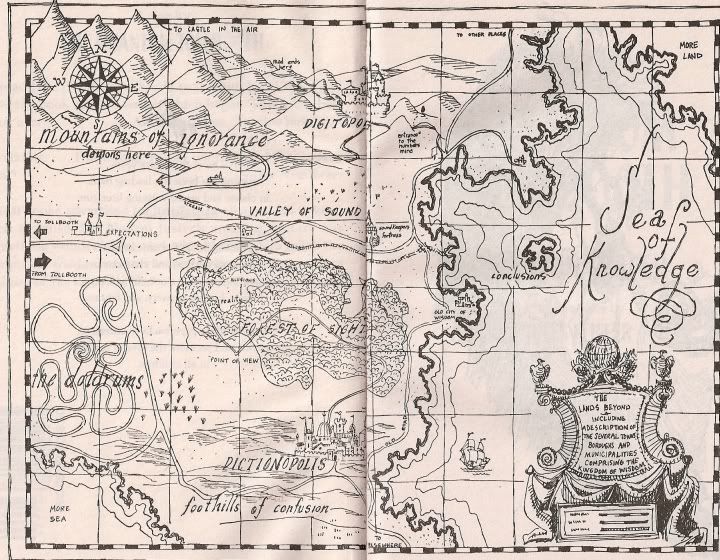
Despite that, I recently pulled my old copy of Norton Juster’s The Phantom Tollbooth off the shelf. I knew some of the wordplay for which this book is justly renowned would go over Dash’s head at this point, but I thought the light, offbeat tone of the narrative would fit his sense of humor pretty well. (Plus there are all those great Jules Feiffer illustrations, which I knew he’d enjoy.) But as I opened it, I tried to remember when Tollbooth had become a cherished book for me. I couldn’t remember the precise age, but I was definitely a good deal older than five.

Still, the book wasn’t a failure with Dash by any means. We read it over several nights of bedtime reading, a few chapters at a time, and he was always ready to return to it each night. It did not become one of those sad, rejected chapter books that never get past the first evening or two, and then sit pathetically on the nightstand until I give up and put them back on the shelf. Dash liked the main characters, especially the trusty watchdog Tock, and the quest storyline. He liked the tone and the humor. He liked the book.

But I didn’t sense he was really into the book, not the way I had been. I’d supposedly prepared myself for this, having realized that Dash might still be a bit young for the weightier issues that make up much of the subtext of Tollbooth, or even that the book might not be as much to his taste as it had been for me. And yet...I couldn’t deny that I felt a little disappointment (which I concealed) that he didn’t just lurve it.

Which brings me back to that parental danger sign. There’s a certain hope in all parents, I think, when we introduce something we love to our kids, whether it be a favorite dessert or a treasured movie or book—and, yes, a certain amount of disappointment when they don’t appear to like it precisely as much as we did (or, worse yet, at all!). Mostly, we’re just after that rush that comes from watching our children experience something that blows them away; when we’ve primed ourselves to expect that, it’s disappointing not to get our fix.

But for me, there was something else, too, something a little uncomfortable: I kind of wanted my kid’s approval of my taste. I suppose even that’s natural enough in a way—I feel the same type of disappointment when a friend tells me she loathed a movie I liked and recommended, for instance. But I don’t want to burden my son with that kind of expectation, that kind of pressure to please me. Even though I’m not telling him openly that I really, really want him to like this book, I know he can probably sense it. (More and more, I come to know that kids sense everything.)

Now, I will certainly continue to bring the books and movies and everything else I loved as a kid to Dash’s attention when he seems ready for them (OK, maybe sometimes a little before). But I’m going to try to leave his personal experience of all this stuff in his own hands, and to keep my expectations—well, not necessarily low, but simply out of the equation as much as I can.

And maybe I’ll hold off on reading Philip Pullman’s (brilliant!) His Dark Materials series with Dash until he’s seven. Or at least six and a half.

[Photo: Whitney Webster]

June 15, 2010

Security Blanket: Mini Grey's Traction Man Books

There are some picture books that, I have to admit, I’m eager to read, day or night. I may even be guilty now and then of attempting to influence my son’s decision on a given evening so he’ll choose one of them for the bedtime read. A lot of these are, of course, old classics I love from my own childhood, but a few are new books that the whole family has grown to love together, as corny as that sounds.

Foremost among them is Mini Grey’s Traction Man series. Grey is an established English author-illustrator whose professional training in theatrical design is obvious from her picture-book work, which is clever and dazzlingly imaginative, and we’ve encountered and enjoyed much of it over the years. But we always return to her Traction Man books—Traction Man Is Here! and Traction Man Meets Turbodog—in which Grey makes brilliant use of the popular sentient-toys trope.

They relate the adventures of a multicostumed, literally square-jawed action figure in the exotic locales of its boy owner’s home: The backyard compost heap is recast as a summit to be conquered; the family cat as a fearsome monster to be avoided. All the proceedings are narrated in the third person with the sonority of a serious nature-expedition documentary: “Traction Man and Turbodog are crossing the wastes of the Sandpit. Somewhere under the shifting sands are the ruins of the Handbag. Maybe that’s a corner of it there. The Handbag Dwellers are very shy.” (Said dwellers, of course, turn out to be old lipsticks and mascaras in Mom’s discarded purse.)

Now, it’s enough fun just to read lines like that in the appropriate Shatner-esque tone of voice, and we’ve amused ourselves and our children doing just that countless times. (Perhaps we should be beginning to get a little less amused after the fiftieth time, but we’re not.) What makes these books especially clever, though, and especially delightful, is the subtext: what’s really happening in the household of Traction Man’s owner. In Traction Man Meets Turbodog, for example, the major plot turn comes when Dad decides that the beloved sidekick of his son’s favorite square-jawed action-hero—a worn-out scrubbing brush named, well, Scrubbing Brush—is filthy and unhygienic and must be replaced. He does so surreptitiously, throwing Scrubbing Brush in the trash one night and presenting the boy with Turbodog, a shiny red battery-powered robotic pet for Traction Man, the next morning.

Now, every parent knows this is trouble. But we don’t see the boy’s reaction to this betrayal directly—instead, we get the confused reaction of Traction Man himself, who wonders where Scrubbing Brush has gotten to as he tries to pursue his normal agenda with Turbodog by his side. (In the aforementioned Sandpit, our hero is forced to rescue his new pet when sand gets in his gears, all the while thinking to himself, “Some sand wouldn’t have stopped Scrubbing Brush. Where is Scrubbing Brush?”)

Naturally, before long Traction Man—the worry in his eyes mirrored by that in the boy’s—must go in search of his beloved sidekick. He looks everywhere, asking some cowboy dust bunnies under a bed if they’ve seen his friend, delving far down into the Grand Sofa Canyon, all in vain—until he hears a muffled noise coming from the outdoor trash can (from which, of course, no one has ever returned alive). But Traction Man, nothing if not loyal and courageous, arms himself with a large spray bottle of SuperStrong Germo with Ammonia and climbs in to fight off the evil Bin-Things and rescue Scrubbing Brush.

It’s impossible to read this stuff without a smile on your face, and kids, quickly getting and enjoying the two levels the story is working on, love it too. Better still, Grey’s books never get old; we come back to them again and again to find the same amount of pleasure we had on first encountering them. In fact, the only complaint I can come up with is that there are only two books in the series thus far. So beyond extreme admiration, that’s my message to Mini Grey: We want more Traction Man adventures!


[Photos: Whitney Webster]